Showing posts with label Mathematics. Show all posts

Monday, December 12, 2016

Richard Feynman Lectures on Physics Complete Volumes


   Read Online                    

The Feynman Lectures on Physics is a 1964 physics textbook by Richard P. Feynman, Robert B. Leighton and Matthew Sands, based upon the lectures given by Feynman to undergraduate students at the California Institute of Technology (Caltech) in 1961–1963. It includes lectures on mathematics, electromagnetism, Newtonian physics, quantum physics, and the relation of physics to other sciences. Six readily accessible chapters were later compiled into a book entitled Six Easy Pieces: Essentials of Physics Explained by Its Most Brilliant Teacher, and six more in Six Not So Easy Pieces: Einstein's Relativity, Symmetry and Space-Time. The first volume focuses on mechanics, radiation, and heat. The second volume is mainly on electromagnetism and matter. The third volume, on quantum mechanics, shows, for example, how the double-slit experiment contains the essential features of quantum mechanics.

By 1960, Richard Feynman’s research and discoveries in physics had resolved a number of troubling inconsistencies in several fundamental theories. In particular, it was his work in quantum electrodynamics which would lead to the awarding in 1965 of the Nobel Prize in physics. At the same time that Feynman was at the pinnacle of his fame, the faculty of the California Institute of Technology was concerned about the quality of the introductory courses being offered to the undergraduate students. It was felt that these were burdened by an old-fashioned syllabus and that the exciting discoveries of recent years, many of which had occurred at Caltech, were not being conveyed to the students.

Thus, it was decided to reconfigure the first physics course offered to students at Caltech, with the goal being to generate more excitement in the students. Feynman readily agreed to give the course, though only once. Aware of the fact that this would be a historic event, Caltech recorded each lecture and took photographs of each drawing made on the blackboard by Feynman. Based on the lectures and the tape recordings, a team of physicists and graduate students put together a manuscript that would become The Feynman Lectures on Physics.

Although Feynman's most valuable technical contribution to the field of physics may have been in the field of quantum electrodynamics, the Feynman Lectures were destined to become his most widely read work.

Sunday, July 24, 2016

Coursera - The Ohio State University - Calculus One


File Size: 4.4 GB

1.) Download and Install Qbittorrent Software

Linux users just type: sudo apt-get install qbittorrent in your terminal.

2.) Download Coursera Calculus One Torrent

Calculus is about the very large, the very small, and how things change. The surprise is that something seemingly so abstract ends up explaining the real world. Calculus plays a starring role in the biological, physical, and social sciences. By focusing outside of the classroom, we will see examples of calculus appearing in daily life.

This course is a first and friendly introduction to calculus, suitable for someone who has never seen the subject before, or for someone who has seen some calculus but wants to review the concepts and practice applying those concepts to solve problems. One learns calculus by doing calculus, and so this course encourages you to participate by providing you with:

* instant feedback on practice problems
* interactive graphs and games for you to play
* calculus projects and demos you can try at home
* opportunities for you to explain your thought process

Saturday, July 23, 2016

Coursera - Pre-Calculus


File Size : 1.1 GB

1.) You need to Download and Install Qbittorrent Software to download these free video course.

Linux users just type : sudo apt-get install qbittorrent

 2.) Download Pre-Calculus Torrent


This Video course covers mathematical topics in algebra and trigonometry and is designed to prepare students to enroll for a first semester course in single variable calculus.

Through this course, students will acquire a solid foundation in algebra and trigonometry. The course concentrates on the various functions that are important to the study of the calculus. Emphasis is placed on understanding the properties of linear, polynomial, piecewise, exponential, logarithmic and trigonometric functions. Students will learn to work with various types of functions in symbolic, graphical, numerical and verbal form.

Below you will find the weekly topic schedule.

  • Week One: Algebra Review. Linear Equations. Linear Inequalities. Absolute Value in Equations and Inequalities.

  • Week Two: Quadratic Equations. Absolute Values. Rational and Radical Equations.

  • Week Three: Functions. Transformations of Graphs.

  • Week Four: Inverse Functions. Polynomials.

  • Week Five: Exponential and Logarithmic Equations.

  • Week Six: Angles and their Measure. Trigonometric Functions. Unit Circle.
          Solving Right Triangles.

  • Week Seven: Properties of Trigonometric Functions. Inverse Trigonometric Functions.

  • Week Eight: Trigonometric Identities: Sum, Difference, Double-Angle and Half-Angle Identities.

  • Week Nine: Trigonometric Equations. Law of Sines. Law of Cosines

  • Week Ten: Review and Final Exam.

Saturday, May 7, 2016

Calculus Better Explained - Kalid Azad


                Ebook Size: 6.4 MB

                Download : Calculus Better Explained - Kalid Azad
 
So. . . What Can I Do With Calculus?

It depends. What can you do with arithmetic? Technically, we don’t need numbers. Our caveman ancestors did fine (well, for some version of “fine”). But having an idea of quantity makes the world a lot easier. You don’t have a “big” and “small” pile of rocks: you have an exact count. You don’t need to describe your mood as “good” or “great” – you can explain your mood from 1 to 10.

Arithmetic provides universal metaphors that go beyond computation, and once seen, they’re difficult to give up. Calculus is similar: it’s a step-by-step view of the world. Do we need X-Ray and Time Lapse vision all the time? Nope. But they’re nice perspectives to “turn on” when we face a puzzling situation. What steps got us here? What’s the next thing that will happen? Where does our future path lead? There are specific rules to calculus, just like there are rules to arithmetic.

And they’re quite useful when you’re cranking through an equation. But don’t forget there are general notions of “quantity” and “step-by-step thinking” that we can bring everywhere. Our primary goal is to feel what a calculus perspective is like (What Would Archimedes Do?). Over time, we’ll work up to using the specific rules ourselves.

Sunday, April 10, 2016

Mathics - A free, light-weight alternative to Mathematica

    
      Ebook Size : 2 MB

      Download : Mathics - A free, light-weight alternative to Mathematica

Mathics—to be pronounced like “Mathematics” without the “emat”—is a general-purpose computer algebra system (CAS). It is meant to be a free, light-weight alternative to Mathematica®. It is free both as in “free beer” and as in “freedom”. There are various online mirrors running Mathics but it is also possible to run Mathics locally. A list of mirrors can be found at the Mathics homepage, http://mathics.github.io.

The programming language of Mathics is meant to resemble Wolfram's famous Mathematica® as much as possible. However, Mathics is in no way affiliated or supported by Wolfram. Mathics will probably never have the power to compete with Mathematica® in industrial applications; yet, it might be an interesting alternative for educational purposes.

Why yet another Computer Algebra System?

Mathematica® is great, but it has one big disadvantage: It is not free. On the one hand, people might not be able or willing to pay hundreds of dollars for it; on the other hand, they would still not be able to see what's going on “inside” the program to understand their computations better. That's what free software is for!

Mathics aims at combining the best of both worlds: the beauty of Mathematica® backed by a free, extensible Python core.

Of course, there are drawbacks to the Mathematica® language, despite all its beauty. It does not really provide object orientation and especially encapsulation, which might be crucial for big software projects. Nevertheless, Wolfram still managed to create their amazing Wolfram|Alpha entirely with Mathematica®, so it can't be too bad!

However, it is not even the intention of Mathics to be used in large-scale projects and calculations—at least not as the main framework—but rather as a tool for quick explorations and in educating people who might later switch to Mathematica®.

Friday, January 15, 2016

Space Math @ NASA - Real World Application of Maths to Space!


SpaceMath@NASA introduces students to the use of mathematics in today's scientific discoveries. Through press releases and other articles, we explore how many kinds of mathematics skills come together in exploring the universe.


The ebooks covers problems and solutions of real world Astronomy by topics, NASA Mission and by Maths Grade Level.

Monday, November 2, 2015

The Life and Achievements of George Boole - 200th Birthday Special


     Ebook Size: 5 MB

     Download : THE LIFE AND ACHIEVEMENTS OF GEORGE BOOLE

Tuesday, October 6, 2015

A Mathematician’s Lament by Paul Lockhart


              Ebook Size : 391 KB

              Download : A Mathematician’s Lament by Paul Lockhart

              The Missing Manual in Mathematics - HDeBooks

The first thing to understand is that mathematics is an art. The difference between math and the other arts, such as music and painting, is that our culture does not recognize it as such. Everyone understands that poets, painters, and musicians create works of art, and are expressing themselves in word, image, and sound. In fact, our society is rather generous when it comes to creative expression; architects, chefs, and even television directors are considered to be working artists. So why not mathematicians? Part of the problem is that nobody has the faintest idea what it is that mathematicians do. The common perception seems to be that mathematicians are somehow connected with science— perhaps they help the scientists with their formulas, or feed big numbers into computers for some reason or other. There is no question that if the world had to be divided into the “poetic dreamers” and the “rational thinkers” most people would place mathematicians in the latter category.

The Ideal Mathematician - Phillip J. David & Reuben Hersh


               Ebook Size : 79 KB

               Download : The Ideal Mathematician

The ideal mathematician's work is intelligible only to a small group of specialists, numbering a few dozen or at most a few hundred. This group has existed only for a few decades, and there is every possibility that it may become extinct in another few decades. However, the mathematician regards his work as part of the very structure of the world, containing truths which are valid forever, from the beginning of time, even in the most remote corner of the universe.

Sunday, September 27, 2015

Handbook of Spoken Mathematics - Larry's Speakeasy

              
                    Ebook Size : 2MB

                    Download :  Handbook of Spoken Mathematics

This handbook answers some of the needs of the many people who have to deal with spoken mathematics, yet have insufficient background to know the correct verbal expression for the written symbolic one. Mathematical material is primarily presented visually, and when this material is presented orally, it can be ambiguous. While the parsing of a written expression is clear and well-defined, when it is spoken this clarity may disappear. For example, “One plus two over three plus OW" can represent the following four numbers, depending on the parsing of the expression: 3/7, 1 2/7, 5 , 5 2 j 3 . However, when the corresponding written expression is seen, there is little doubt which of the four numbers it represents. When reading mathematics orally, such problems are frequently encountered. Of course, the written expression may always be read symbol by symbol, but if the expression is long or there are a cluster of expressions, it can be very tedious and hard to understand. Thus, whenever possible, one wishes to have the written expression spoken in a way that is interest retaining and easy to understand.

In an attempt to alleviate problems such as these, this handbook has been compiled to establish some consistent and well-defined ways of uttering mathematical expressions so that listeners will receive clear, unambiguous, and well-pronounced representations of the subject.

Monday, August 24, 2015

Mathematics for Computer Science - Eric Lehman, F. Thomson Leighton, Albert R. Meyer

                      Ebook Size : 1.6MB

                      Download :  Mathematics for Computer Science

This book covers elementary discrete mathematics for computer science and engineering. It emphasizes mathematical definitions and proofs as well as applicable methods. Topics include formal logic notation, proof methods; induction, well-ordering; sets, relations; elementary graph theory; integer congruences; asymptotic notation and growth of functions; permutations and combinations, counting principles; discrete probability. Further selected topics may also be covered, such as recursive definition and structural induction; state machines and invariants; recurrences; generating functions.

Sunday, August 23, 2015

Calculus Based Physics Volume II - Jeffrey W. Schnick


                  Ebook Size : 2.3 MB

                  Download : Calculus Based Physics Volume II

You might well wonder why we start off a physics book with a chapter on mathematics. The thing is, the mathematics covered in this chapter is mathematics you are supposed to already know. The problem is that you might be a little bit rusty with it. We don’t want that rust to get in the way of your learning of the physics. So, we try to knock the rust off of the mathematics that you are supposed to already know, so that you can concentrate on the physics.

As much as we emphasize that this is a physics course rather than a mathematics course, there is no doubt that you will advance your mathematical knowledge if you take this course seriously. You will use mathematics as a tool, and as with any tool, the more you use it the better you get at using it. Some of the mathematics in this book is expected to be new to you. The mathematics that is expected to be new to you will be introduced in recitation on an as-needed basis. It is anticipated that you will learn and use some calculus in this course before you ever see it in a mathematics course.

This book is addressed most specifically to students who have never had a physics course before and have never had a calculus course before but are currently enrolled in a calculus course. If you have already taken calculus, physics, or both, then you have a well earned advantage.

Saturday, August 22, 2015

Calculus Based Physics Volume I - Jeffrey W. Schnick


                Ebook Size : 1.9 MB

                Download : Calculus Based Physics Volume I

One of your goals in taking a physics course is to become more proficient at solving physics problems, both conceptual problems involving little to no math, and problems involving some mathematics. In a typical physics problem you are given a description about something that is taking place in the universe and you are supposed to figure out and write something very specific about what happens as a result of what is taking place. More importantly, you are supposed to communicate clearly, completely, and effectively, how, based on the description and basic principles of physics, you arrived at your conclusion. To solve a typical physics problem you have to: (1) form a picture based on the given description, quite often a moving picture, in your mind, (2) concoct an appropriate mathematical problem based on the picture, (3) solve the mathematical problem, and (4) interpret the solution of the mathematical problem. The physics occurs in steps 1, 2, and 4. The mathematics occurs in step 3. It only represents about 25% of the solution to a typical physics problem.

Saturday, July 11, 2015

The Perfect Maths Lesson, Totally Practical! - Ian Loynd

                            Ebook Size: 873 KB

                            Download: The Perfect Maths Lesson

As someone who struggled with maths growing up, I often asked/wailed, ‘Why are we learning this?’ Ian understands the need to bring the real world into the classroom, to give maths value and to engage learners so that they have a reason to show up. He provides pupils with stimulating real-life contexts that will challenge and prepare them, not make-believe contexts used simply to practice
strategies or pass a test. Therefore, young people can adapt to our ‘compressed global community’ whilst becoming better learners; they are learning to learn in maths to empower them for the future.

So, why should you read this book? Like any good teacher, regardless of subject area, Ian knows you have to hook pupils in and challenge them from the off, but then maintain this pace and balance throughout the lesson: he summarises how to do this with top tips. I will be keeping this book to hand as a gentle reminder and to try out some of his practical ideas and activities (from starters to original and creative assessment opportunities) to ‘perplex, mystify and delightfully baffle’ learners, which he succeeded in doing to this reader many times. He even includes mathematical jokes and inspirational sayings, as he knows that learning for children is emotional and they have to enjoy it.

His handy checklists guide you through the whole process of the planning, delivery and assessment of an outstanding lesson, with references to Ofsted’s expectations, although the learners are the main concern, first and foremost. There are even novel ways of setting homework which promote real independent learning (not just working on your own) and the discipline for students to push themselves.

Wednesday, February 27, 2013

1001 Math Problems Fast, Focused Practice that Improves Your Math Skills


               Ebook Size : 1.8 MB

            Download : 1001 Math Problems that Improves Your Math Skills.pdf

Are you frightened of mathematics? You’re not alone. By the time I was nine, I had developed a full-blown phobia. In fact, my most horrible moments in grade school took place right before an arithmetic test. My terror—and avoidance—lasted well into adulthood, until the day I landed a job with a social service agency and was given the task of figuring budgets, which involved knowing how to do percentages. I might just as well have been asked to decipher the strange squiggles incised on the nose-cone of an alien spaceship. I decided I’d better do something quick, so I went to a friend of mine, a fifth-grade teacher, and asked her to design a short course for me.

We met on Sundays for almost a year. She began each tutorial with a short lecture on the type of problem we would be working with, and then provided me with a yellow legal pad and a photocopied set of problems—and sat doing crossword puzzles while I labored. We worked our way up to geometry that way, and on into algebra.

“Mathematics works,” she told me early on. “Don’t ask why. Just do the problems. One day the light will dawn.”

Tuesday, February 12, 2013

How to Calculate Quickly - Full Course in Speed Arithmetic - Henry Sticker


                      Ebook Size : 5.1 MB

                  Download : How to Calculate Quickly.pdf

Many useful procedures explained and taught: 2-column addition, left-to-right subtraction, direct multiplication by numbers greater than 12, mental division of large numbers, more. Also numerous helpful shortcuts. More than 8,000 problems, with solutions. 1945 edition.

Monday, February 4, 2013

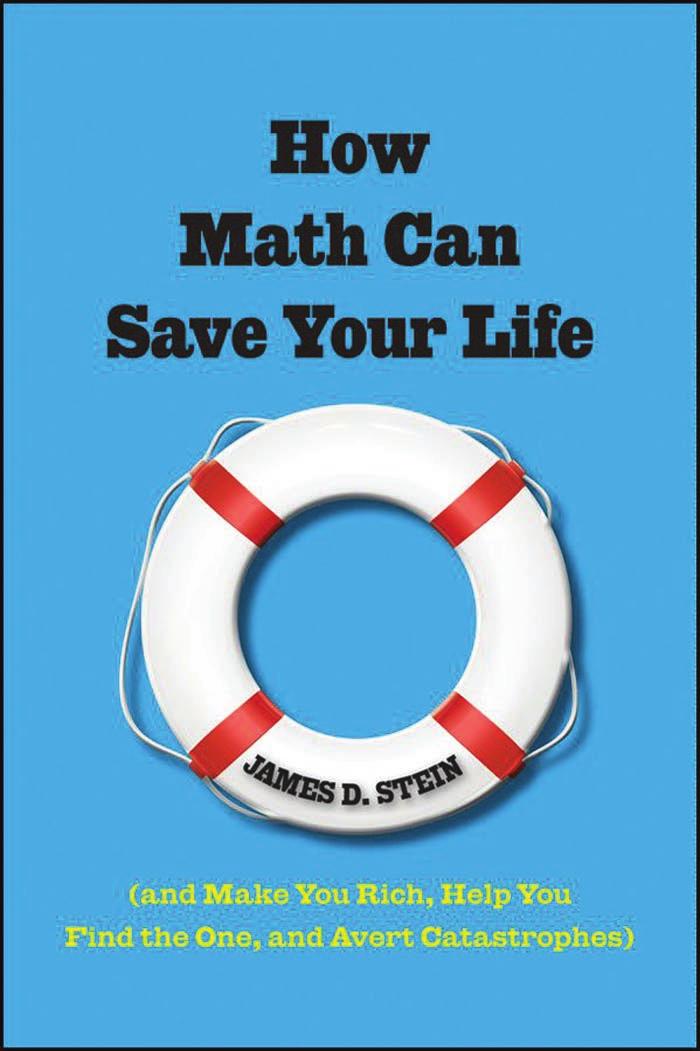
How Math Can Save Your Life - James D. Stein


                      Ebook Size : 1.8 MB

                      Download : How Math Can Save Your Life.pdf

We can get a good idea of how education has changed in the United States by taking a look inside a little red schoolhouse in the heartland of America a little more than a century ago.

What constitutes value? On a philosophical level, I’m not sure; what’s valuable for one person may not be for others. The most philosophically valuable thing
I’ve ever learned is that bad times are always followed by good times and vice versa, but that may simply be a lesson specific to yours truly. On the other hand, if this lesson helps you, that’s value added to this chapter. And if this chapter
helps you financially, even better—because there is one universal common denominator of value that everyone accepts:money.

That’s why this chapter is valuable, because I’m going to discuss a few basic concepts that will be worth tens of thousands—maybe even hundreds of thousands—of dollars to you. So let’s get started.

A penny saved is still a penny earned, but nowadays you can’t even slip a penny into a parking meter—so let me make this book a worthwhile investment by saving you a few thousand dollars. The next time you go to buy an appliance and the salesperson offers you a service contract, don’t even consider purchasing it. A simple table and a little sixth-grade math should convince you.

Wednesday, December 19, 2012

The Large Scale Structure of Space-Time - Stephen Hawking & G.F.R.Ellis

      
       Ebook Size : 15 MB

       Download : The Large Scale Structure of Space-Time.pdf


In this book we shall study the large scale structure of space-time on the basis of Einstein's General Theory of Relativity. The predictions of this theory are in agreement with all the experiments so far performed. However our treatment will be sufficiently general to cover modifications of Einstein's theory such as the Brans-Dicke theory.

While we expect that most of our readers will have some acquaintance with General Relativity, we have endeavored to write this book so that it is self-contained apart from requiring a knowledge of simple calculus, algebra and point set topology.  We have therefore devoted chapter 2 to differential geometry. Our treatment is reasonably modern in that we have formulated our definitions in a manifestly coordinate independent  manner. However for computational convenience we do use indices at times, and we have for the most part avoided the use of fibre bundles. The reader with some knowledge of differential geometry may wish to skip this chapter.

Sunday, December 2, 2012

100 Great Problems of Elementary Mathematics - Heinrich Dorrie


Ebook Size : 10.7 MB

Download : 100 Great Problems of Elementary Mathematics.pdf

A book collecting the celebrated problems of elementary mathematics that would commemorate their origin and, above all, present their solutions briefly, clearly, and comprehensibly has long seemed a necessary and attractive task to the author.

The restriction to problems of elementary mathematics was considered advisable in view of those readers who have neither the time nor the opportunity to acquaint themselves in any detail with higher mathematics. Nevertheless, in spite of this limitation a colorful and compelling picture has emerged, one that gives an idea of the amazing variety of mathematical methods and one that will-I hope-enchant many who are interested in mathematics and who take pleasure in characteristic mathematical thought processes. In the present work there are to be found many pearls of mathematical art, problems the solutions of which represent, in the achievements of a Gauss, an Euler, Steiner, and others, incredible triumphs of the mathematical mind. Because the difficult economic situation at the present time barred the publication of a larger work, a limit had to be set to the scope and number of the problems treated. Thus, I decided on a round number of one hundred problems. Moreover, since many of the problems and solutions require considerable space despite the greatest concision, this had to be compensated for by the inclusion of a number of mathematical miniatures. Possibly, however, it may be just these little problems, which are, in their way, true jewels of mathematical miniature work, that will find the readiest readers and win new admirers for the queen of the sciences.

As we have indicated already, a knowledge of higher analysis is not assumed.  Consequently, the Taylor expansion could not be used for the treatment of the important infinite series.  I  hope nonetheless that the derivations we have given, particularly the striking derivation of the sine and cosine series, will please and will not be found unattractive even by mathematically sophisticated readers.

Thursday, November 29, 2012

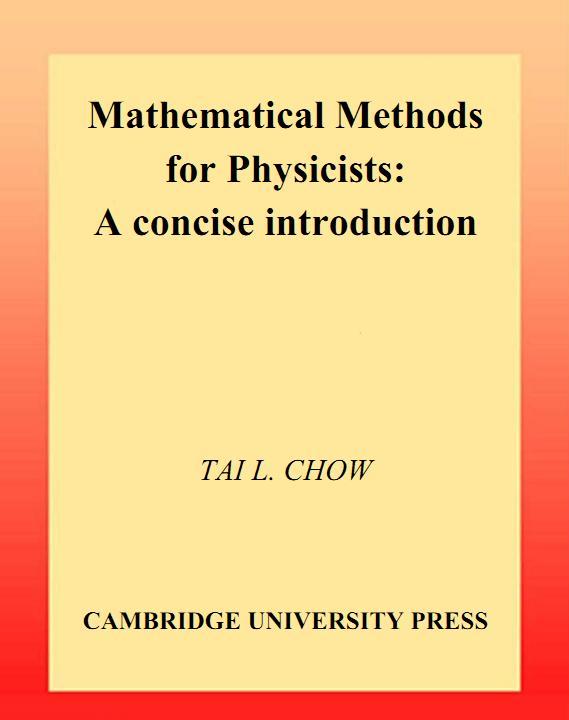
Mathematical Methods for Physicists: A concise introduction - Tai L. Chow


                  Ebook Size : 5.6 MB

                  Download : Mathematical Methods for Physicists.pdf 

This text is designed for an intermediate-level, two-semester undergraduate course in mathematical physics. It provides an accessible account of most of the current, important mathematical tools required in physics. The book bridges the gap between an introductory physics course and more advanced courses in classical mechanics, electricity and magnetism, quantum mechanics, and thermal and statistical physics. It contains a large number of worked examples to illustrate the mathematical techniques developed and to show their relevance to physics. The highly organized coverage allows instructors to teach the basics in one semester. The book could also be used in courses in engineering, astronomy, and mathematics.