Showing posts with label General Science. Show all posts

Sunday, June 4, 2017

The Demon Haunted World - Carl Sagan


                       Ebook Size : 4.4 MB

                       Download : The Demon Haunted World - Carl Sagan

    "SCIENCE AS A CANDLE IN THE DARK"

It was a blustery fall day in 1939. In the streets outside the apartment building, fallen leaves were swirling in little whirl winds, each with a life of its own. It was good to be inside and warm and safe, with my mother preparing dinner in the next room. In our apartment there were no older kids who picked on you for no reason. Just the week before, I had been in a fight – I can't remember, after all these years, who it was with; maybe it was Snoony Agata from the third floor - and, after a wild swing, I found I had put my fist through the plate glass window of Schechter's drug store.

Mr Schechter was solicitous: 'It's all right, I'm insured,' he said as he put some unbelievably painful antiseptic on my wrist. My mother took me to the doctor whose office was on the ground floor of our building. With a pair of tweezers, he pulled out a fragment of glass. Using needle and thread, he sewed two stitches.

'Two stitches!' my father had repeated later that night. He knew about stitches, because he was a cutter in the garment industry; his job was to use a very scary power saw to cut out patterns - backs, say, or sleeves for ladies' coats and suits - from an enormous stack of cloth. Then the patterns were conveyed to endless rows of women sitting at sewing machines. He was pleased I had gotten angry enough to overcome a natural timidity. Sometimes it was good to fight back. I hadn't planned to do anything violent. It just happened. One moment Snoony was pushing me and the next moment my fist was through Mr Schechter's window. I had injured my wrist, generated an unexpected medical expense, broken a plate glass window, and no one was mad at me. As for Snoony, he was more friendly than ever.

I puzzled over what the lesson was. But it was much more pleasant to work it out up here in the warmth of the apartment, gazing out through the living-room window into Lower New York Bay, than to risk some new misadventure on the streets below. As she often did, my mother had changed her clothes and made up her face in anticipation of my father's arrival. We talked about my fight with Snoony. The Sun was almost setting and together we looked out across the choppy waters. 'There are people fighting out there, killing each other,' she said, waving vaguely across the Atlantic. I peered intently. 'I know,' I replied. 'I can see them.' 'No, you can't,' she replied, sceptically, almost severely, before returning to the kitchen. 'They're too far away.'

How could she know whether I could see them or not? I wondered. Squinting, I had thought I'd made out a thin strip of land at the horizon on which tiny figures were pushing and shoving and duelling with swords as they did in my comic books. But maybe she was right. Maybe it had just been my imagination, a little like the midnight monsters that still, on occasion, awakened me from a deep sleep, my pyjamas drenched in sweat, my heart pounding.

How can you tell when someone is only imagining? I gazed out across the grey waters until night fell and I was called to wash my hands for dinner. When he came home, my father swooped me up in his arms. I could feel the cold of the outside world against his one-day growth of beard. On a Sunday in that same year, my father had patiently explained to me about zero as a placeholder in arithmetic, about the wicked-sounding names of big numbers, and about how there's no biggest number ('You can always add one,' he pointed out). Suddenly, I was seized by a childish compulsion to write in sequence all the integers from 1 to 1,000. We had no pads of paper, but my father offered up the stack of grey cardboards he had been saving from when his shirts were sent to the laundry.

Friday, June 2, 2017

International Space Station Research Results Accomplishments


             Ebook Size : 23 MB

             Download : International Space Station

NASA’s International Space Station (ISS) celebrated 15 years of operations in November 2013 and is living up to expectations as a leading space laboratory, hosting state-of-the-art science facilities, and providing researchers with a continuous microgravity environment to conduct investigations across many disciplines.

From the first ISS element, launched in November 1998, the ISS has supported investigations and technology demonstrations that will advance NASA’s human exploration capabilities beyond low Earth Orbit (LEO), and improve the daily lives of people on Earth well beyond its operational lifetime. The first 15 years of utilization on ISS has helped answer scientific questions ranging from “How do fluids flow in space?” to “What are the origins of the universe?” The science and technology returns have grown at a steady pace. Even before the assembly of ISS was completed in 2011, the on-orbit crew were busy performing experiments, and with the full complement of a 6 person crew, more than 1 600 investigations have been conducted to date across the international partnership.

This report is intended to provide an archival record of the internationally-sponsored ISS research results collected for investigations performed from 2000-2011 on ISS (Expedition 0 through 30), including scientific publications from studies based on operational data. These investigations represent the research of thousands of scientists around the globe, and have impacts beyond the field of space research into traditional areas of science in multidisciplinary ways that no Earth-based laboratory has done. Yet much like a typical laboratory on Earth, the logistics of the ISS allows for many investigations to be carried forward over several ISS crew expeditions, enabling repeated experimentation and data collection that traditional science calls for. One example of this is the Seedling Growth-1 (SG-1) joint NASA-ESA experiment that was implemented as an extension of the earlier Tropi-1 and Tropi-2 plant growth experiments that first confirmed the existence red-light based phototropism in roots and hypocotyls of seedlings. Researchers were able to capitalize on Tropi results in the SG-1 design by improving different lighting conditions, decreasing seed storage time, and adding real-time seedling observation through improved image downlink [4] .

The results from ISS have so far yielded updated new insights into how to better live and work in space, such as addressing radiation effects on crew health [4] , combating bone and muscle loss [1, 7] , improving designs of systems that handle fluids in microgravity [12] , and how to most efficiently maintain environmental control [15] . Latest examples of the ISS utilization applications relevant to our life on Earth is published in the second edition of the ISS Benefits for Humanity, which documents several tangible benefits that have resulted from ISS utilization in areas of Earth Observation and Disaster Response, Human Health, Global Education, Innovative Technology, and Economic Development of Space [2] . These benefits include such examples of how space-based research leads to improvements in therapies for balance disorders [2, 16] and contributions to improvements in smart fluids for advanced braking systems and earthquake dampening devices [2, 6] . ISS results also show promise in diverse applications such as medicine [2, 10] and global maritime tracking [11] and have advanced our knowledge of our planet’s health while also contributing to disaster response efforts [2, 13, 9, 8] . With all its diversity, the ISS continues to inspire millions of students in ways that only space can [14, 5, 3] .

The ISS offers a unique platform for science with critical capabilities not available anywhere else. It provides long-duration microgravity exposure, thermosphere exposure, and external environment exposure for material observations at high inclination, altitude, and velocity. The microgravity environment of the ISS allows scientists to observe unique behaviors that are otherwise masked by gravity on Earth, such as thermocapillary and fluid flows, protein crystal growth, flame structures, and the structure of living cells. The ISS platform also provides access to extreme heat and cold cycles, ultra vacuum, atomic oxygen, and high-energy radiation.

Saturday, December 24, 2016

8,760 hours how to get the most out of next year - Alex Vermeer


   Ebook Size : 6 MB

   Download : 8,760 hours how to get the most out of next year


This is a guide for planning the next 8,760 hours—one full year—of your life. More importantly, it is about creating a detailed plan and optimizing for success, based on an understanding of what works.

For the last few years this system has worked very well for me. My hope is that you will find it useful as well. Many of the ideas here are not original to me. This guide builds off many hours of reading many articles and blogs about productivity, goals, and the brain, which are attributed when possible. 1 The end result is a system for keeping yourself constantly moving towards your goals over the next year, and constantly staying on track.

Why plan at all? Want to learn an instrument? Want to write a book? Want to beat every computer game ever designed? Want to cure cancer? Want to have a positive impact on the world and an impactful career? Do you have something to protect, something that gets you out of bed in the morning? Whatever your primary motivations are in life, you won’t get anywhere by waiting for something to happen. We plan because we have sh*t we want to do with our lives. Humans do not think strategically by default. Even when we know what our goals are—and we often don’t—we are still bad at asking things like:

➙ ➙ What exactly do I want to achieve?

➙ ➙ How will I measure success?

➙ ➙ Am I actively seeking out information about this?

➙ ➙ Can I break this down into more manageable parts?

➙ ➙ Is this really my goal? Am I constrained by fears or uncertainties?

Our brains are not optimized for achieving our larger goals in life. They are sculpted by evolution for survival and reproductive abilities, but not much else! We need systems and processes in place to help us get around these evolutionary “abilities” so that we can get the most out of our lives.

Your life in a nutshell (“life is short”) If you live to be 80 years old, which is about the first-world average life expectancy, then you will experience about 30,000 days or 700,000 hours of life (if we take out sleeping time the number drops to more like 450,000 hours).

The point is that we have limited time and we must choose how to spend it. Unfortunately, from personal experience, I rarely take the time to consciously do this. The only way to decide what to work on is to prioritize. That’s why I take a big picture approach to life and break down the big picture into present year and day actions.

This is part of my motivation for calling this guide “8,760 hours” rather than “one year.” Even if there is a sense that life is incredibly short, there are still 8,760 hours in a single year! That is a lot of time to get some real stuff done.

Given that our natural life-planning skills are... lacking, this guide hopes to help us overcome that limitation and get things done anyway.

Monday, May 16, 2016

COSMOS - Carl Sagan


                          Ebook Size : 1.1 MB

                          Download : COSMOS - Carl Sagan

The Cosmos is all that is or ever was or ever will be. Our feeblest contemplations of the Cosmos stir us - there is a tingling in the spine, a catch in the voice, a faint sensation, as if a distant memory, of falling from a height. We know we are approaching the greatest of mysteries.

The size and age of the Cosmos are beyond ordinary human understanding. Lost somewhere between immensity and eternity is our tiny planetary home. In a cosmic perspective, most human concerns seem insignificant, even petty. And yet our species is young and curious and brave and shows much promise. In the last few millennia we have made the most astonishing and unexpected discoveries about the Cosmos and our place within it, explorations that are exhilarating to consider. They remind us that humans have evolved to wonder, that understanding is a joy, that knowledge is prerequisite to survival. I believe our future depends on how well we know this Cosmos in which we float like a mote of dust in the morning sky.

Those explorations required skepticism and imagination both. Imagination will often carry us to worlds that never were. But without it, we go nowhere. Skepticism enables us to distinguish fancy from fact, to test our speculations. The Cosmos is rich beyond measure - in elegant facts, in exquisite interrelationships, in the subtle machinery of awe.
  
In the summer and fall of 1976, as a member of the Viking Lander Imaging Flight Team, I was engaged, with a hundred of my scientific colleagues, in the exploration of the planet Mars. For the first time in human history we had landed two space vehicles on the surface of another world. The results, described more fully in Chapter 5, were spectacular, the historical significance of the mission utterly apparent. And yet the general public was learning almost nothing of these great happenings. The press was largely inattentive; television ignored the mission almost altogether.

When it became clear that a definitive answer on whether there is life on Mars would not be forthcoming, interest dwindled still further. There was little tolerance for ambiguity. When we found the sky of Mars to be a kind of pinkish-yellow rather than the blue which had erroneously first been reported, the announcement was greeted by a chorus of good-natured boos from the assembled reporters - they wanted Mars to be, even in this respect, like the Earth. They believed that their audiences would be progressively disinterested as Mars was revealed to be less and less like the Earth. And yet the Martian landscapes are staggering, the vistas breathtaking. I was positive from my own experience that an enormous global interest exists in the exploration of the planets and in many kindred scientific topics - the origin of life, the Earth, and the Cosmos, the search for extraterrestrial intelligence, our connection with the universe. And I was certain that this interest could be excited through that most powerful communications medium, television.

Saturday, April 16, 2016

The Autobiography of Benjamin Franklin


    Ebook Size : 771 KB

    Download : The Autobiography of Benjamin Franklin

Tuesday, October 6, 2015

Free. Open-source. Peer-reviewed. High-quality books for your college course.


                                      Visit openstax books Website

Thursday, August 20, 2015

nature collections - Nature's Summer Reads


              Ebook Size: 13.8 MB

              Download: Nature Summer Reads

Summer means different things to different people. It can be a time to broaden horizons by travelling to new places; a time to catch up on news and ideas that have swept past this year; and of course, a time to read. Here, Nature offers the opportunity to do all these things, with a collection of the best and most popular stories published in the magazine’s award-winning News Features section in 2015. The stories include something for all tastes. One feature, on page 7, explores how advances in genetics and developmental biology have been challenging the idea that there is a clear distinction between the sexes, and finds that perhaps sex should be considered as more of a spectrum.

In medicine, the collection includes a story about a largely unrecognized, but pressing global health problem: the astonishing rise in short-sightedness that has been taking place over the past few decades, particularly in Asian countries, and how it might be curbed (page 18). Pluto was thrust into the spotlight this summer when New Horizons reached its quarry, some 4.8 billion kilometres from Earth. A profile in the collection (page 11) tells the story of two scientists, a brother and sister, who have been captivated by the planet since their youth. On page 33, a feature looks at experiments to uncover the nature of the wavefunction – the mysterious entity that lies at the heart of quantum weirdness –and page 41 captures the excitement in the science of 2D materials that has followed the discovery of graphene. Nature’s News Features editors have enjoyed publishing every one of these stories; we hope that your summer is
enriched by reading them.

Sunday, July 26, 2015

Mind Hacking - Sir John Hargrave


                Ebook Size : 1.3 MB

                Download : Mind Hacking.pdf

The first few months of sobriety were unbearable, and so was I. Every day was a roulette wheel of emotion: I could be furious, anxious, sulky, moody, or depressed, often simultaneously. One thought, however, slowly began to sprout a little bud of hope. What if there was a way to reprogram my mind?

Programming is in my blood. One of my earliest memories was my father taking me to visit the computer lab at the university where he worked. In my mind, the college's mainframe computer stood illuminated by a shaft of divine light, with a choir of angelic voices. In reality, it was probably fluorescent light, and the whirr of industrial air conditioning units. But the effect on me was no less profound: somehow, that moment implanted a little seedling of geek into my tender, eight-year-old uterus. Please don't ask me why I had a uterus.

My father approached the resident computer programmer, a heavyset man with a large, walrus-like mustache. "Ronald, this is John," my father introduced me.
"Hey." Ronald looked down at me, tape reels spinning in the background. (I might be mixing up some details of this story with a series of TV commercials for Control Data Institute.) "What can I do for you?" "Can you create a punch card with John's name on it?" my father asked.

"Sure." Ronald handed me a card, a little larger than an index card, with small rectangular holes punched out. It seemed to glow in my hands, a cryptic piece of alien technology. It was mind-blowing to stand in that computer lab, among those massive, mysterious machines that required a swimming pool of coolant to keep them from overheating. I had the distinct feeling that in here was another world. I lost the punch card, but I'll never lose that memory.

When the cost of your own computer -- your very own computer! -- finally became affordable, I would pore over computer catalogs like earlier generations of kids would fantasize about Red Ryder BB Guns. I drooled over the latest machines with sexy names like "TRS-80" and "TI-99/4A," the pages of my catalogs stuck together with saliva and nerd sweat. I begged, cajoled, and badgered my parents, until they finally bought me the legendary Commodore 64, the computer that changed my life.

They didn't just buy me a computer, they let me keep it in my room. There I began programming with a vengeance. There wasn't much to do in my hometown, so I immersed myself in the secret language of computers, teaching myself the basics: flowcharts, algorithms, variables, loops. I was lucky enough to get in the first programming class taught at my middle school, and by the end of the semester, I was teaching the teachers.

Tuesday, July 21, 2015

Science - A Discovery in Comics - Margreet de Heer

  
  Ebook Size : 43 MB

  Download: Science - A Discovery in Comics - Margreet de Heer


Explaining different scientific disciplines in clear, colorful chapters, this illustrated primer is a great way to introduce young readers to a complex topic. In her easily accessible style, Margreet de Heer visualizes science and makes it approachable for those with little knowledge of the subject. Touching a number of topics in various scientific disciplines--including math, chemistry, physics, biology, geology, and quantum theory--this work ponders questions such as Who exclaimed "Eureka" and why? Why did Galileo get into a fight with the Church? and What happens when you have your DNA tested? This humorous yet substantive graphic account strips the subject of unnecessary complexity, making it a perfect introduction to exploring scientific concepts.

Margreet de Heer lives and works in Amsterdam, The Netherlands, with her husband Yiri T. Kohl and two cats. A long time ago, she studied Theology at the University of Amsterdam, but through divine intervention she ended up being a comic artist. She worked at the famous comic store Lambiek from 2000 until 2005, and wrote a book about Dutch comics together with Kees Kousemaker. Since 2005, the same year she contributed to the 24 Hour Comic Day Anthology, she is a full-time comic artist producing a wide range of work, from children's comics in magazines to cartoons at business conferences. In 2007 she started making philosophical comic "reports" for newspaper Trouw. This resulted in a book edition in 2010 which was published in the US by NBM Publishing with the title 'Philosophy: a Discovery in Comics' in 2012. Margreet continued the series with a comic book about religion in 2011, followed by one about science in 2012. The latter is published in the US with the title 'Science: a Discovery in Comics', in September 2013.

Saturday, July 18, 2015

Find Your Purpose Using Science - Gleb Tsipursky


   Ebook Size: 4.7 MB

   Download : Find Your Purpose Using Science

   Buy this book on Amazon!


What is the meaning and purpose of life for you? Please take a moment to reflect on this question. Whether you have asked yourself this question before or not, it is very helpful to check in from time to time, and ask yourself, with an open heart and open mind, once again. After all, your answer may shift over time, including by reading this book, which lays out a science-based path to help you find a deep sense of meaning and purpose in life. Using science to address life’s meaning and purpose may seem surprising to many. After all, the traditional mainstream approach believes that science can’t answer big life questions –
that’s the job of religion. Well, actually there’s been a wave of recent research in psychology, cognitive neuroscience, and other disciplines on how we can find a rich sense of meaning and purpose in life. The workbook combines an engaging narrative, academic research, and stories from people’s everyday lives, and provides a set of exercises to help you figure out your personal sense of meaning and purpose. In writing this, I drew on my own scholarship on meaning and
purpose, and my experience in giving workshops, teaching classes, creating videos, and writing blog posts that translate such research into practical strategies for finding life meaning and purpose.

Now, many people who come to my workshops and classes are looking for a simple, clear,and straightforward answer to what life is all about. They want certainty about life’s meaning and purpose. Well, I’d love to address life’s meaning and purpose for all people and for all time, but I can’t give the absolute right answer to the big question of “what is the meaning of life.” I don’t deal in sound bites and dogmas.

What I can do in this book is provide you some clear and practical research-based strategies for figuring out a personal sense of life’s meaning and purpose. In other words, I offer the answer to the question “what is the meaning of life for you?” Those who attended my workshops and classes on this topic found these techniques very helpful. One participant stated in an anonymous feedback form that s/he gained “a better understanding of what it means to search for meaning, with the research basis especially greatly contributing to my comprehension.” A second noted that after attending the workshop, “I have a much better sense of how to consider questions of meaning and purpose.” A third wrote that “from attending this workshop, I have gained the basic knowledge for greater self-exploration.” Several chose to give videotaped interviews about their experience in a workshop on meaning and purpose. They kindly permitted me to include their names and links to their videotaped feedback, for example Ryan Mulholand; Brenda Penn; Karen Thimmes, and Jake
Calaway. Their descriptions of their experience testifies to how much they benefitted from engaging with the research-based strategies to finding a deeper sense of meaning and purpose in life. I got in touch with some of these workshop participants a few weeks after the workshop, to see whether it influenced them in the long term. It did. The most illustrative statement came from Ryan, whose story I will share throughout this book. Ryan, who is a 21-year-old college student, stated that when he first came to the workshop, “my original highest order goals revolved largely around living a comfortable life.” Yet in the course of the workshop, he realized that “the issue with this mindset was that it was too shallow and self-centered for me to be content with for long.” As a result of the workshop, he stated that “ “I reached several conclusions in what I desired most out of life. I figured out that I wanted to build a life that was centered around bettering myself and other people. I wanted to be someone who constantly was learning and growing, while at the same time, being a teacher of sorts to help
those around me... With these thoughts in mind, I promptly changed my major and have since then, begun to work toward making these wants into realities.” His full statement describing his experience is available here.

Friday, February 14, 2014

Pioneers of Science - Oliver Lodge


        Ebook Size : 788 KB

       Download : Pioneers of Science

Compiled for the general reader and first published in 1893, this illustrated collection of lectures is a whistle-stop history of astronomical discoveries from the ancient world to the modern era. It includes concise explanations of theory in non-technical terms, biographical notes on significant astronomers, and more than a hundred illustrations. This scarce antiquarian book is a facsimile reprint of the original. Due to its age, it may contain imperfections such as marks, notations, marginalia and flawed pages. Because we believe this work is culturally important, we have made it available as part of our commitment for protecting, preserving, and promoting the world's literature in affordable, high quality, modern editions that are true to the original work.

Sunday, February 10, 2013

Ideas and Opinions by Albert Einstein


                   Ebook Size : 13.5 MB

                   Download : Ideas and Opinions by Albert Einstein.pdf

 A new edition of the most definitive collection of Albert Einstein's popular writings, gathered under the supervision of Einstein himself. The selections range from his earliest days as a theoretical physicist to his death in 1955; from such subjects as relativity, nuclear war or peace, and religion and science, to human rights, economics, and government.

IDEAS AND OPINIONS contains essays by eminent scientist Albert Einstein on subjects ranging from atomic energy, relativity, and religion to human rights, government, and economics. Previously published articles, speeches, and letters are gathered here to create a fascinating collection of meditations by one of the world's greatest minds. --This text refers to an out of print or unavailable edition of this title.

"Ideas and Opinions reveals Albert Einstein, perhaps the greatest scientist of all time, as a whole human being . . . a deeply moral and philosophical thinker, whose clarity in human affairs matched his clarity in science. . . .
Purity and inspiration shine through every page of this extraordinary book."
--Alan Lightman --This text refers to the Hardcover edition.


Monday, May 14, 2012

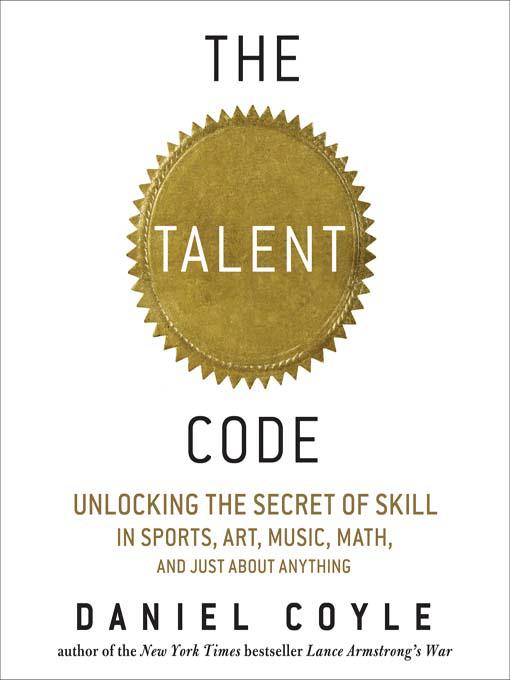
The Talent Code by Daniel Coyle


                     Ebook Size : 5.6 MB
                
                     Download : The Talent Code by Daniel Coyle.pdf


What is the secret of talent? How do we unlock it? In this groundbreaking work, journalist and New York Times bestselling author Daniel Coyle provides parents, teachers, coaches, businesspeople—and everyone else—with tools they can use to maximize potential in themselves and others.

Whether you’re coaching soccer or teaching a child to play the piano, writing a novel or trying to improve your golf swing, this revolutionary book shows you how to grow talent by tapping into a newly discovered brain mechanism.

Drawing on cutting-edge neurology and firsthand research gathered on journeys to nine of the world’s talent hotbeds—from the baseball fields of the Caribbean to a classical-music academy in upstate New York—Coyle identifies the three key elements that will allow you to develop your gifts and optimize your performance in sports, art, music, math, or just about anything.

• Deep Practice--Everyone knows that practice is a key to success. What everyone doesn’t know is that specific kinds of practice can increase skill up to ten times faster than conventional practice.

• Ignition--We all need a little motivation to get started. But what separates truly high achievers from the rest of the pack? A higher level of commitment—call it passion—born out of our deepest unconscious desires and triggered by certain primal cues. Understanding how these signals work can help you ignite passion and catalyze skill development.

• Master Coaching--What are the secrets of the world’s most effective teachers, trainers, and coaches? Discover the four virtues that enable these “talent whisperers” to fuel passion, inspire deep practice, and bring out the best in their students.

These three elements work together within your brain to form myelin, a microscopic neural substance that adds vast amounts of speed and accuracy to your movements and thoughts. Scientists have discovered that myelin might just be the holy grail: the foundation of all forms of greatness, from Michelangelo’s to Michael Jordan’s. The good news about myelin is that it isn’t fixed at birth; to the contrary, it grows, and like anything that grows, it can be cultivated and nourished.

Combining revelatory analysis with illuminating examples of regular people who have achieved greatness, this book will not only change the way you think about talent, but equip you to reach your own highest potential.