Showing posts with label Physics. Show all posts

Tuesday, May 30, 2017

The Pleasure of Finding Things Out - Richard Feynman


                        Ebook Size : 7.6 MB

                        Download : The Pleasure of Finding Things Out


Recently I was present at a lecture at Harvard University’s venerable Jefferson Lab. The speaker was Dr. Lene Hau of the Rowland Institute, who had just conducted an experiment that was reported not only in the distinguished scientific journal Nature but also on the front page of the New York Times. In the experiment, she (with her research group of students and scientists) passed a laser beam through a new kind of matter called a Bose-Einstein condensate (a weird quantum state in which a bunch of atoms, cooled almost to absolute zero, practically stop moving at all and together act like a single particle), which slowed that light beam to the unbelievably leisurely pace of 38 miles per hour. Now light, which normally travels at the breakneck pace of 186,000 miles per second, or 669,600,000 miles per hour, in a vacuum, does typically slow down whenever it passes through any medium, such as air or glass, but only by a fraction of a percent of its speed in vacuo. But do the arithmetic and you will see that 38 miles per hour divided by 669.6 million miles per hour equals 0.00000006, or six-millionths of a percent, of its speed in vacuo. To put this result in perspective, it is as if Galileo had dropped his cannonballs from the Tower of Pisa and they took two years to reach the ground.

I was left breathless by the lecture (even Einstein would have been impressed, I think). For the first time in my life I felt a smidgen of what Richard Feynman called “the kick in the discovery,” the sudden feeling (probably akin to an epiphany, albeit in this case a vicarious one) that I had grasped a wonderful new idea, that there was something new in the world; that I was present at a momentous scientific event, no less dramatic or exciting than Newton’s feeling when he realized that the mysterious force that caused that apocryphal apple to land on his head was the same force that caused the moon to orbit the earth; or Feynman’s when he achieved that first grudging step toward understanding the nature of the interaction between light and matter, which led eventually to his Nobel Prize.

Sitting among that audience, I could almost feel Feynman looking over my shoulder and whispering in my ear, “You see? That’s why scientists persist in their investigations, why we struggle so desperately for every bit of knowledge, stay up nights seeking the answer to a problem, climb the steepest obstacles to the next fragment of understanding, to finally reach that joyous moment of the kick in the discovery, which is part of the pleasure of finding things out.”* Feynman always said that he did physics not for the glory or for awards and prizes but for the fun of it, for the sheer pleasure of finding out how the world works, what makes it tick.

Feynman’s legacy is his immersion in, and dedication to, science-its logic, its methods, its rejection of dogma, its infinite capacity to doubt. Feynman believed and lived by the credo that science, when used responsibly, can not only be fun but can also be of inestimable value to the future of human society. And like all great scientists, Feynman loved sharing his wonder of nature’s laws with colleagues and laypersons alike. Nowhere is Feynman’s passion for knowledge more clearly displayed than in this collection of his short works (most previously published, one unpublished).

The best way to appreciate the Feynman mystique is to read this book, for here you will find a wide range of topics about which Feynman thought deeply and discoursed so charmingly, not only physics-in the teaching of which he was surpassed by no one-but also religion, philosophy, and academic stage fright; the future o f computing, and of nanotechnology, of which he was the first pioneer; humility, fun in science, and the future of science and civilization; how budding scientists should view the world; and the tragic bureaucratic blindness that led to the Space Shuttle Challenger disaster, the headline-making report that made “Feynman” a household word. Remarkably, there is very little overlap in these pieces, but in those few places where a story is repeated in another piece, I took the liberty of deleting one of the two occurrences to spare the reader needless repetition. I inserted ellipses (...) to indicate where a repeated “gem” has been deleted. Feynman had a very casual attitude toward proper grammar, as clearly shows in most o f the pieces, which were transcribed from spoken lectures or interviews. 

To maintain the Feynman flavor, therefore, I generally let stand his ungrammatical turns o f phrase. However, where poor or sporadic transcription made a word or phrase incomprehensible or awkward, I edited it for readability. I believe that the result is virtually unspoiled, yet readable, Feynmanese. Acclaimed during his lifetime, revered in memory, Feynman continues to be a source o f wisdom to people from all walks of life. I hope this treasury of his best talks, interviews, and articles will stimulate and entertain generations of devoted fans and newcomers to Feynman’s unique and often rambunctious mind.

So read, enjoy, and don’t be afraid to laugh out loud occasionally or to learn a lesson or two about life; be inspired; above all, experience the pleasure of finding things out about an uncommon human being. I would like to thank Michelle and Carl Feynman for their generosity and constant support from both coasts; Dr. Judith Goodstein, Bonnie Ludt, and Shelley Erwin of the Caltech archives for their indispensable help and hospitality; and especially professor Freeman Dyson for his elegant and enlightening Foreword. I would also like to express my thanks to John Gribbin, Tony Hey, Melanie Jackson, and Ralph Leighton for their frequent and excellent advice throughout the making of this book.

                                                                                                 Jeffrey Robbins,
                                                                                          Reading, Massachusetts,
                                                                                                 September 1999

This is the edited transcript of an interview with Feynman made for the BBC television program Horizon in 1981, shown in the United States as an episode of Nova. Feynman had most of his life behind him by this time (he died in 1988), so he could reflect on his experiences and accomplishments with the perspective not often attainable by a younger person. The result is a candid, relaxed, and very personal discussion on many topics close to Feynman’s heart: why knowing merely the name of something is the same as not knowing anything at all about it; how he and his fellow atomic scientists of the Manhattan Project could drink and revel in the success of the terrible weapon they had created while on the other side of the world in Hiroshima thousands of their fellow human beings were dead or dying from it; and why Feynman could just as well have gotten along with out a Nobel Prize.

Monday, December 12, 2016

Richard Feynman Lectures on Physics Complete Volumes


   Read Online                    

The Feynman Lectures on Physics is a 1964 physics textbook by Richard P. Feynman, Robert B. Leighton and Matthew Sands, based upon the lectures given by Feynman to undergraduate students at the California Institute of Technology (Caltech) in 1961–1963. It includes lectures on mathematics, electromagnetism, Newtonian physics, quantum physics, and the relation of physics to other sciences. Six readily accessible chapters were later compiled into a book entitled Six Easy Pieces: Essentials of Physics Explained by Its Most Brilliant Teacher, and six more in Six Not So Easy Pieces: Einstein's Relativity, Symmetry and Space-Time. The first volume focuses on mechanics, radiation, and heat. The second volume is mainly on electromagnetism and matter. The third volume, on quantum mechanics, shows, for example, how the double-slit experiment contains the essential features of quantum mechanics.

By 1960, Richard Feynman’s research and discoveries in physics had resolved a number of troubling inconsistencies in several fundamental theories. In particular, it was his work in quantum electrodynamics which would lead to the awarding in 1965 of the Nobel Prize in physics. At the same time that Feynman was at the pinnacle of his fame, the faculty of the California Institute of Technology was concerned about the quality of the introductory courses being offered to the undergraduate students. It was felt that these were burdened by an old-fashioned syllabus and that the exciting discoveries of recent years, many of which had occurred at Caltech, were not being conveyed to the students.

Thus, it was decided to reconfigure the first physics course offered to students at Caltech, with the goal being to generate more excitement in the students. Feynman readily agreed to give the course, though only once. Aware of the fact that this would be a historic event, Caltech recorded each lecture and took photographs of each drawing made on the blackboard by Feynman. Based on the lectures and the tape recordings, a team of physicists and graduate students put together a manuscript that would become The Feynman Lectures on Physics.

Although Feynman's most valuable technical contribution to the field of physics may have been in the field of quantum electrodynamics, the Feynman Lectures were destined to become his most widely read work.

Thursday, November 3, 2016

Fundamentals of Astrodynamics by Roger R. Bate


                         Ebook Size : 14.3 MB

                         Download : Fundamentals of Astrodynamics


In 1665 Newton was a student at the University of Cambridge when an outbreak of the plague forced the university to close down for 2 years. Those 2 years were to be the most creative period in Newton's life. The 23-year-old genius conceived the law of gravitation, the laws of motion and developed the fundamental concepts of the differential calculus during the long vacation of 1666, but owing to some small discrepancies in his explanation of the moon's motion he tossed his papers aside. The world was not to learn of his momentous discoveries until some 20 years later!

To Edmund Halley, discoverer of Halley's comet, is due the credit for bringing Newton's discoveries before the world. One day in 1685 Halley and two of his contemporaries, Christopher Wren and Robert Hooke, were discussing the theory of Descartes which explained the motion of the planets by means of whirlpools and eddies which swept the planets around the sun. Dissatisfied with this explanation, they speculated whether a force. "similar to magnetism " and falling off inversely with the square of distance might not require the planets to move in precisely elliptical paths. Hooke thought that this should be easy to prove whereupon Wren offered Hooke 40 shillings if he could produce the proof with in 2 weeks. The 2 weeks passed and nothing more was heard from Hooke.

Several months later Halley was visiting Newton at Cambridge and, without mentioning the bet, casually posed the question, "If the sun pulled the planets with a force inversely proportional to the square of their distances, in what paths ought they to go? " To Halley's utter and complete astonishment Newton replied without hesitation, "Why, in ellipses, of course. I have already calculated it and have the proof among my papers somewhere. Give me a few days and I shall find it for you." Newton was referring to the work he had done some 20 years earlier and only in this casual way was his greatest discovery made known to the world!

Halley, when he recovered from his shock, advised his reticent friend to develop completely and to publish his explanation of planetary motion. The result took 2 years in preparation and appeared in 1687 as The Mathematical Principles of Natural Philosophy, or, more simply, the Principia, undoubtedly one of the supreme achievements of the human mind.

Monday, October 3, 2016

Hacking Matter - Wil McCarthy


   Ebook Size : 2.3 MB

   Download : Hacking Matter - WIL MCCARTHY


"When he experimented with lightning, Ben Franklin mused that electricity 'might someday prove of use.' Now comes Wil McCarthy, offering a peek at something so potentially transforming, our grandchildren may build civilizations around it. If even a few of these possibilities come true, you'll always remember you heard it here first." -- David Brin, author of The Transparent Society

"Programmable substances and futuristic computers will revolutionize our lives and allow us to soar beyond the limits of our intuition. No book better describes the impact of hypercomputing and the dazzling wealth of new materils coming our way than Hacking Matter." -- Clifford A. Pickover, author of The Mathematics of Oz

"A grand tour of cutting-edge research: alchemy, 21st century style. The author makes an informative case for the promising, even magical, potential of programmable atoms." -- Publishers Weekly

McCarthy effectively conveys the inherent gee-whiz character of his subject. A fascinating glimpse of research that may in a few years find its way into our everyday lives." --Kirkus Reviews

"[T]he book's science is solid and McCarthy's fervor genuinely infectious. The future never felt so close." -- Jennifer Kahn, WIRED


"McCarthy blends lucid nuts-and-bolts explanations of 'quantum dots' and other developing technologies with healthy doses of 'You ain't seen nothin' yet' descriptions of speculative applications. A fascinating book for any reader intrigued by new technologies." -- Barnes and Noble

"Promises to create a thunderclap of change. McCarthy takes a fantastical concept, coolly explaining it in a plausible way, and helps even the most science-deficient reader to understand how 'hacking matter' works, and what it means for all of us." -- Dallas Morning News
 
At the nanoscale, where we find very tiny, very simple objects like the water molecule (about 0.3 nm across at its widest), these rules barely apply at all. Instead, the behavior of particles is governed by quantum mechanics, that elusive and slippery physics pioneered in the time of Einstein. Quantum mechanics is almost completely counterintuitive; your "gut feel" about how a particle should behave is virtually useless for predicting what it will actually do. This is because on the nanoscale, what we call "particles" are really probability waves -- regions where a particle-like phenomenon is more or less likely to occur. Probability waves can do "impossible" things like leaping across an impenetrable barrier, or existing in many places at the same time, or apparently predicting the future, or being influenced by distant events much faster than the speed of light should allow.

Sunday, October 2, 2016

The Collected Papers of Albert Einstein


        Read Online

Friday, September 23, 2016

Sustainable Energy – Without the Hot Air - David JC MacKay

    
          Ebook Size : 13.9 MB

          Download :  Sustainable Energy – Without the Hot Air


Everyone says getting off fossil fuels is important, and we’re all encouraged to “make a difference,” but many of the things that allegedly make a difference  don’t add up. Twaddle emissions are high at the moment because people get  emotional (for example about wind farms or nuclear power) and no-one talks about numbers. Or if they do mention numbers, they select them to sound big, to make an impression, and to score points in arguments, rather than to aid thoughtful discussion.

This is a straight-talking book about the numbers. The aim is to guide the reader around the claptrap to actions that really make a difference and to policies that add up.


if everyone does a little, we’ll achieve only a little.


So, if humanity succeeds in doubling or tripling CO 2 concentrations (which is  where we are certainly heading, under business as usual), what happens? Here, there is a lot of uncertainty. Climate science is difficult. The climate is a complex, twitchy beast, and exactly how much warming CO 2 - doubling would produce is uncertain. The consensus of the best climate models seems to be that doubling the CO 2 concentration would have roughly the same effect as increasing the intensity of the sun by 2%, and would bump up the global mean temperature by something like 3◦C. This would be what historians call a Bad Thing.

I won’t recite the whole litany of probable drastic effects, as I am sure you’ve heard it before. The litany begins “the Greenland icecap would gradually melt, and, over a period of a few 100 years, sea-level would rise by about 7 metres.” The brunt of the litany falls on future generations. Such temperatures have not been seen on earth for at least 100 000 years, and it’s conceivable that the ecosystem would be so significantly altered that the earth would stop supplying some of the goods and services that we currently take for granted.

Friday, January 15, 2016

What is LIFE? by ERWIN SCHRODINGER

                                Ebook Size: 277 KB

                                Download : What is LIFE? by ERWIN SCHRODINGER

 
What is life? The Physical Aspect of the Living Cell.
Based on lectures delivered under the auspices of the Dublin Institute for Advanced Studies at Trinity College, Dublin, in February 1943.

To the memory of My Parents

Preface

A scientist is supposed to have a complete and thorough I of knowledge, at first hand, of some subjects and, therefore, is usually expected not to write on any topic of which he is not a life, master. This is regarded as a matter of noblesse oblige. For the present purpose I beg to renounce the noblesse, if any, and to be the freed of the ensuing obligation. My excuse is as follows: We have inherited from our forefathers the keen longing for unified, all-embracing knowledge. The very name given to the highest institutions of learning reminds us, that from antiquity to and throughout many centuries the universal aspect has been the only one to be given full credit. But the spread, both in and width and depth, of the multifarious branches of knowledge by during the last hundred odd years has confronted us with a queer dilemma. We feel clearly that we are only now beginning to acquire reliable material for welding together the sum total of all that is known into a whole; but, on the other hand, it has become next to impossible for a single mind fully to command more than a small specialized portion of it. I can see no other escape from this dilemma (lest our true who aim be lost for ever) than that some of us should venture to embark on a synthesis of facts and theories, albeit with second-hand and incomplete knowledge of some of them -and at the risk of making fools of ourselves. So much for my apology. The difficulties of language are not negligible. One's native speech is a closely fitting garment, and one never feels quite at ease when it is not immediately available and has to be replaced by another. My thanks are due to Dr Inkster (Trinity College, Dublin), to Dr Padraig Browne (St Patrick's College, Maynooth) and, last but not least, to Mr S. C. Roberts. They were put to great trouble to fit the new garment on me and to even greater trouble by my occasional reluctance to give up some 'original' fashion of my own. Should some of it have survived the mitigating tendency of my friends, it is to be put at my door, not at theirs. The headlines of the numerous sections were originally intended to be marginal summaries, and the text of every chapter should be read in continuo. E.S. Dublin September 1944 Homo liber nulla de re minus quam de morte cogitat; et ejus sapientia non mortis sed vitae meditatio est. SPINOZA'S Ethics, Pt IV, Prop. 67 (There is nothing over which a free man ponders less than death; his wisdom is, to meditate not on death but on life.)

Tuesday, August 25, 2015

Hubble 25: A Quarter-Century of Discovery with the Hubble Space Telescope!


                 Ebook Size : 189 MB

                 Download : Hubble 25: The Hubble Space Telescope

On April 24, 1990, NASA’s Space Shuttle Discovery blasted off from the Florida coast carrying precious cargo that was destined to revolutionize the way humans see the cosmos. The Hubble Space Telescope had been decades in the making, the dream of astronomers who yearned to study the universe with a clear view unhindered by the distorting influence of Earth’s atmosphere. A day after launch, Discovery’s astronauts fulfilled that dream by releasing Hubble into orbit hundreds of miles above the ground, and more importantly, above the bulk of our planet’s atmosphere.

Hubble was not the first telescope launched into space, nor is it the largest telescope at astronomers’ disposal. Hubble’s exceptional and ongoing capacity to help unveil the secrets of the universe comes not just from its position beyond Earth’s atmosphere and, as a result, its exquisite image quality, but also its ability to be upgraded with new science instruments — a unique feature among space-based telescopes. After Hubble’s launch, shuttle astronauts returned to the telescope five times to install new cameras, detectors, and other equipment built with ever-more advanced technology, keeping Hubble on the leading edge of astronomy. Hubble’s suite of instruments also allows the observatory to record wavelengths of light not just in the visible range but in ultraviolet and near-infrared wavelengths (which are not visible to our eyes), including some wavelength ranges that cannot be observed from the ground.

The Hubble Space Telescope is an instrument of science — one of the most productive in history. Thousands of astronomers from around the world have used Hubble to explore nearly every facet of the universe, publishing more than 11,000 scientific papers in the process. Still, the magnificent images Hubble  takes have proven time and again their power to capture the hearts and minds of scientists and non-scientists alike. The majestic scenes fire the imagination and inspire awe for the astonishing vastness of the cosmos and all the wonders it contains. To celebrate Hubble’s 25th anniversary, this book presents 25 of the most remarkable images Hubble has acquired so far. They are ordered according to distance from Earth, highlighting Hubble’s great range, from observing planets in our own solar system to the stars and galaxies born when the universe was still young. Each chapter in this book introduces one of Hubble’s images and points out some of the features that Hubble’s exceptional vision reveals. It also describes a sample of the related scientific research or discoveries achieved with Hubble. Supplemental images and videos provide more context and help bring the subject to life.


Now 25 years into its trailblazing mission, Hubble’s greatest accomplishments to date include helping to uncover black holes in the centers of galaxies, observing changes on planets in our solar system, investigating the atmospheres of planets around stars other than the Sun, seeing disks that are possibly forming new solar systems, and hunting down nascent galaxies in the very early universe. Astronomers have also used Hubble to follow up on the work done almost a century ago by the telescope’s namesake, the astronomer Edwin Hubble, whose observations of galaxies revealed that the universe was expanding. Observing with the Hubble telescope, astronomers have refined their calculation for the universe’s expansion rate and discovered the existence of a force called dark energy, which is causing the universe to expand faster and faster as time goes on.

Hubble’s work is far from finished, though. Astronomers are continuing to use the orbiting observatory to extend their view and understanding of the cosmos ever farther. In 2009, during Hubble’s final servicing mission, astronauts installed new science instruments, batteries, computers, gyroscopes, and other equipment that will keep the observatory hot on the trail of the most pressing celestial mysteries for years to come.

Sunday, August 23, 2015

Calculus Based Physics Volume II - Jeffrey W. Schnick


                  Ebook Size : 2.3 MB

                  Download : Calculus Based Physics Volume II

You might well wonder why we start off a physics book with a chapter on mathematics. The thing is, the mathematics covered in this chapter is mathematics you are supposed to already know. The problem is that you might be a little bit rusty with it. We don’t want that rust to get in the way of your learning of the physics. So, we try to knock the rust off of the mathematics that you are supposed to already know, so that you can concentrate on the physics.

As much as we emphasize that this is a physics course rather than a mathematics course, there is no doubt that you will advance your mathematical knowledge if you take this course seriously. You will use mathematics as a tool, and as with any tool, the more you use it the better you get at using it. Some of the mathematics in this book is expected to be new to you. The mathematics that is expected to be new to you will be introduced in recitation on an as-needed basis. It is anticipated that you will learn and use some calculus in this course before you ever see it in a mathematics course.

This book is addressed most specifically to students who have never had a physics course before and have never had a calculus course before but are currently enrolled in a calculus course. If you have already taken calculus, physics, or both, then you have a well earned advantage.

Saturday, August 22, 2015

Calculus Based Physics Volume I - Jeffrey W. Schnick


                Ebook Size : 1.9 MB

                Download : Calculus Based Physics Volume I

One of your goals in taking a physics course is to become more proficient at solving physics problems, both conceptual problems involving little to no math, and problems involving some mathematics. In a typical physics problem you are given a description about something that is taking place in the universe and you are supposed to figure out and write something very specific about what happens as a result of what is taking place. More importantly, you are supposed to communicate clearly, completely, and effectively, how, based on the description and basic principles of physics, you arrived at your conclusion. To solve a typical physics problem you have to: (1) form a picture based on the given description, quite often a moving picture, in your mind, (2) concoct an appropriate mathematical problem based on the picture, (3) solve the mathematical problem, and (4) interpret the solution of the mathematical problem. The physics occurs in steps 1, 2, and 4. The mathematics occurs in step 3. It only represents about 25% of the solution to a typical physics problem.

Thursday, August 20, 2015

nature collections - Nature's Summer Reads


              Ebook Size: 13.8 MB

              Download: Nature Summer Reads

Summer means different things to different people. It can be a time to broaden horizons by travelling to new places; a time to catch up on news and ideas that have swept past this year; and of course, a time to read. Here, Nature offers the opportunity to do all these things, with a collection of the best and most popular stories published in the magazine’s award-winning News Features section in 2015. The stories include something for all tastes. One feature, on page 7, explores how advances in genetics and developmental biology have been challenging the idea that there is a clear distinction between the sexes, and finds that perhaps sex should be considered as more of a spectrum.

In medicine, the collection includes a story about a largely unrecognized, but pressing global health problem: the astonishing rise in short-sightedness that has been taking place over the past few decades, particularly in Asian countries, and how it might be curbed (page 18). Pluto was thrust into the spotlight this summer when New Horizons reached its quarry, some 4.8 billion kilometres from Earth. A profile in the collection (page 11) tells the story of two scientists, a brother and sister, who have been captivated by the planet since their youth. On page 33, a feature looks at experiments to uncover the nature of the wavefunction – the mysterious entity that lies at the heart of quantum weirdness –and page 41 captures the excitement in the science of 2D materials that has followed the discovery of graphene. Nature’s News Features editors have enjoyed publishing every one of these stories; we hope that your summer is
enriched by reading them.

Tuesday, July 28, 2015

The Grand Design - Stephen Hawking and Leonard Mlodinow


                       Ebook Size : 10.4 MB
     
                       Download : The Grand Design

WE EACH EXIST FOR BUT A SHORT TIME, and in that time explore but a small part of the whole universe. But humans are a curious species. We wonder, we seek answers. Living in this vast world that is by turns kind and cruel, and gazing at the immense heavens above, people have always asked a multitude of questions: How can we understand the world in which we find ourselves? How does the universe behave? What is the nature of reality? Where did all this come
from? Did the universe need a creator? Most of us do not spend most of our time worrying about these questions, but almost all of us worry about them some of the time. Traditionally these are questions for philosophy, but philosophy is dead. Philosophy has not kept up with modern developments in science, particularly physics. Scientists have become the bearers of the torch of discovery in our quest for knowledge. The purpose of this book is to give the answers that are suggested by recent discoveries and theoretical advances. They lead us to a new
picture of the universe and our place in it that is very different from the traditional one, and different even from the picture we might have painted just a decade or two ago. Still, the first sketches of the new concept can be traced back almost a century.

According to the traditional conception of the universe, objects move on well-defined paths and have definite histories. We can specify their precise position at each moment in time. Although that account is successful enough for everyday purposes, it was found in the 1920s that this “classical” picture could not account for the seemingly bizarre behavior observed on the atomic and subatomic scales of existence. Instead it was necessary to adopt a different framework, called quantum physics. Quantum theories have turned out to be remarkably accurate at predicting events on those scales, while also reproducing the predictions of the old classical theories when applied to the macroscopic world of daily life. But quantum and classical physics are based on very different conceptions of physical reality. 

Tuesday, July 21, 2015

Science - A Discovery in Comics - Margreet de Heer

  
  Ebook Size : 43 MB

  Download: Science - A Discovery in Comics - Margreet de Heer


Explaining different scientific disciplines in clear, colorful chapters, this illustrated primer is a great way to introduce young readers to a complex topic. In her easily accessible style, Margreet de Heer visualizes science and makes it approachable for those with little knowledge of the subject. Touching a number of topics in various scientific disciplines--including math, chemistry, physics, biology, geology, and quantum theory--this work ponders questions such as Who exclaimed "Eureka" and why? Why did Galileo get into a fight with the Church? and What happens when you have your DNA tested? This humorous yet substantive graphic account strips the subject of unnecessary complexity, making it a perfect introduction to exploring scientific concepts.

Margreet de Heer lives and works in Amsterdam, The Netherlands, with her husband Yiri T. Kohl and two cats. A long time ago, she studied Theology at the University of Amsterdam, but through divine intervention she ended up being a comic artist. She worked at the famous comic store Lambiek from 2000 until 2005, and wrote a book about Dutch comics together with Kees Kousemaker. Since 2005, the same year she contributed to the 24 Hour Comic Day Anthology, she is a full-time comic artist producing a wide range of work, from children's comics in magazines to cartoons at business conferences. In 2007 she started making philosophical comic "reports" for newspaper Trouw. This resulted in a book edition in 2010 which was published in the US by NBM Publishing with the title 'Philosophy: a Discovery in Comics' in 2012. Margreet continued the series with a comic book about religion in 2011, followed by one about science in 2012. The latter is published in the US with the title 'Science: a Discovery in Comics', in September 2013.

Monday, December 2, 2013

Physics of the Future - Michio Kaku


                       Ebook Size : 2.5 MB

                   Download : Physics of the Future.pdf

When I was a child, two experiences helped to shape the person I am today and spawned two passions that have helped to define my entire life.

First, when I was eight years old, I remember all the teachers buzzing with the latest news that a great scientist had just died. That night, the newspapers printed a picture of his office, with an unfinished manuscript on his desk. Thecaption read that the greatest scientist of our era could not finish his greatest masterpiece. What, I asked myself, could be so difficult that such a great scientist could not finish it? What could possibly be that complicated and that important? To me, eventually this became more fascinating than any murder mystery, more intriguing than any adventure story. I had to know what was in that unfinished manuscript.

Later, I found out that the name of this scientist was Albert Einstein and the unfinished manuscript was to be his crowning achievement, his attempt to create a “theory of everything,” an equation, perhaps no more than one inch wide, that would unlock the secrets of the universe and perhaps allow him to “read the  mind of God.”

But the other pivotal experience from my childhood was when I watched the Saturday morning TV shows, especially the Flash Gordon series with Buster Crabbe. Every week, my nose was glued to the TV screen. I was magically transported to a mysterious world of space aliens, starships, ray gun battles, underwater cities, and monsters. I was hooked. This was my first exposure to the world of the future. Ever since, I’ve felt a childlike wonder when pondering the future.

But after watching every episode of the series, I began to realize that although Flash got all the accolades, it was the scientist Dr. Zarkov who actually made the series work. He invented the rocket ship, the invisibility shield, the power source for the city in the sky, etc. Without the scientist, there is no future. The handsome and the beautiful may earn the admiration of society, but all the wondrous inventions of the future are a by-product of the unsung, anonymous scientists.

Later, when I was in high school, I decided to follow in the footsteps of these great scientists and put some of my learning to the test. I wanted to be part of this great revolution that I knew would change the world. I decided to build an atom smasher. I asked my mother for permission to build a 2.3-million electron volt particle accelerator in the garage. She was a bit startled but gave me the okay. Then, I went to Westinghouse and Varian Associates, got 400 pounds of transformer steel, 22 miles of copper wire, and assembled a betatron accelerator in my mom’s garage.

Previously, I had built a cloud chamber with a powerful magnetic field and photographed tracks of antimatter. But photographing antimatter was not enough. My goal now was to produce a beam of antimatter. The atom smasher’s
magnetic coils successfully produced a huge 10,000 gauss magnetic field (about 20,000 times the earth’s magnetic field, which would in principle be enough to rip a hammer right out of your hand). The machine soaked up 6 kilowatts of power, draining all the electricity my house could provide. When I turned on the machine, I frequently blew out all the fuses in the house. (My poor mother must have wondered why she could not have a son who played football instead.)

So two passions have intrigued me my entire life: the desire to understand all the physical laws of the universe in a single coherent theory and the desire to see the future. Eventually, I realized that these two passions were actually complementary. The key to understanding the future is to grasp the fundamental laws of nature and then apply them to the inventions, machines, and therapies that will redefine our civilization far into the future. There have been, I found out, numerous attempts to predict the future, many useful and insightful.  However, they were mainly written by historians, sociologists, science fiction writers, and “futurists,” that is, outsiders who are predicting the world of science without a firsthand knowledge of the science itself. The scientists, the insiders who are actually creating the future in their laboratories, are too busy making breakthroughs to have time to write books about the future for the public.

That is why this book is different. I hope this book will give an insider’s perspective on what miraculous discoveries await us and provide the most authentic, authoritative look into the world of 2100.

Tuesday, August 20, 2013

College Physics - A complete Text Book on Physics


   Ebook Size : 28.1 MB

  Downoad : College Physics.pdf

What is your first reaction when you hear the word “physics”? Did you imagine working through difficult equations or memorizing formulas that seem to have no real use in life outside the physics classroom? Many people come to the subject of physics with a bit of fear. But as you begin your exploration of this broad-ranging subject, you may soon come to realize that physics plays a much larger role in your life than you first thought, no matter your life goals or career choice.

For example, take a look at the image above. This image is of the Andromeda Galaxy, which contains billions of individual stars, huge clouds of gas, and dust. Two smaller galaxies are also visible as bright blue spots in the background. At a staggering 2.5 million light years from the Earth, this galaxy is the nearest one to our own galaxy (which is called the Milky Way). The stars and planets that make up Andromeda might seem to be the furthest thing from most people’s regular, everyday lives. But Andromeda is a great starting point to think about the forces that hold together the universe.

The forces that cause Andromeda to act as it does are the same forces we contend with here on Earth, whether we are planning to send a rocket into space or simply raise the walls for a new home. The same gravity that causes the stars of Andromeda to rotate and revolve also causes water to flow over hydroelectric dams here on Earth. Tonight, take a moment to look up at the stars. The forces out there are the same as the ones here on Earth. Through a study of physics, you may gain a greater understanding of the interconnectedness of everything we can see and know in this universe.

Think now about all of the technological devices that you use on a regular basis. Computers, smart phones, GPS systems, MP3 players, and satellite radio might come to mind. Next, think about the most exciting modern technologies that you have heard about in the news, such as trains that levitate above tracks, “invisibility cloaks” that bend light around them, and microscopic robots that fight cancer cells in our bodies. All of these groundbreaking advancements, commonplace or unbelievable, rely on the principles of physics.

Aside from playing a significant role in technology, professionals such as engineers, pilots, physicians, physical therapists, electricians, and computer programmers apply physics concepts in their daily work. For example, a pilot must understand how wind forces affect a flight path and a physical therapist must understand how the muscles in the body experience forces as they move and bend. As you will learn in this text, physics principles are propelling new, exciting technologies, and these principles are applied in a wide range of careers.

In this text, you will begin to explore the history of the formal study of physics, beginning with natural philosophy and the ancient Greeks, and leading up through a review of Sir Isaac Newton and the laws of physics that bear his name. You will also be introduced to the standards scientists use when they study physical quantities and the interrelated system of measurements most of the scientific community uses to communicate in a single mathematical language. Finally, you will study the limits of our ability to be accurate and precise, and the reasons scientists go to painstaking lengths to be as clear as possible regarding their own limitations.

Science consists of the theories and laws that are the general truths of nature as well as the body of knowledge they encompass. Scientists are continually trying to expand this body of knowledge and to perfect the expression of the laws that describe it. Physics is concerned with describing the interactions of energy, matter, space, and time, and it is especially interested in what fundamental mechanisms underlie every phenomenon. The concern for describing the basic phenomena in nature essentially defines the realm of physics.

Physics aims to describe the function of everything around us, from the movement of tiny charged particles to the motion of people, cars, and spaceships. In fact, almost everything around you can be described quite accurately by the laws of physics. Consider a smart phone.

Physics describes how electricity interacts with the various circuits inside the device. This knowledge helps engineers select the appropriate materials and circuit layout when building the smart phone. Next, consider a GPS system. Physics describes the relationship between the speed of an object, the distance over which it travels, and the time it takes to travel that distance. When you use a GPS device in a vehicle, it utilizes these physics equations to determine the travel time from one location to another.

Wednesday, July 17, 2013

Lectures on Dynamics and Relativity - David Tong


           Ebook Size: 1.1 MB

         Download : Lectures on Dynamics and Relativity.pdf

Classical mechanics is an ambitious theory. Its purpose is to predict the future and reconstruct the past, to determine the history of every particle in the Universe. The theory of classical mechanics was formulated by Newton in 1687, building on earlier insights of Galileo. Starting from a few simple axioms, Newton constructed a mathematical framework which is powerful enough to explain a broad range of phenomena, from the orbits of the planets, to the motion of the tides, to the scattering of elementary particles. Before it can be applied to any specific problem, the framework needs just a single input: a force. With this in place, it is merely a matter of turning a mathematical handle to reveal what happens next. We start this course by exploring the framework of Newtonian mechanics, understanding the axioms and what they have to tell us about the way the Universe works.

We then move on to look at a number of forces that are at play in the world. Nature is kind and the list is surprisingly short. Moreover, many of forces that arise have special properties, from which we will see new concepts emerging such as energy and conservation principles. Finally, for each of these forces, we turn the mathematical handle. We turn this handle many many times. In doing so, we will see how classical mechanics is able to explain large swathes of what we see around us. Despite its wild success, Newtonian mechanics is not the last word in theoretical physics. It struggles in extremes: the realm of the very small, the very heavy or the very fast. We finish these lectures with an introduction to special relativity, the theory which replaces Newtonian mechanics when the speed of particles is comparable to the speed of light. We will see how our common sense ideas of space and time are replaced by something more intricate and more beautiful, with surprising consequences. Time goes slow for those on the move; lengths get smaller; mass is merely another form of energy.

Ultimately, the framework of classical mechanics falls short of its ambitious goal to tell the story of every particle in the Universe. Yet it provides the basis for all that follows. Some of the Newtonian ideas do not survive to later, more sophisticated, theories of physics. Even the seemingly primary idea of force will fall by the wayside. Instead other concepts that we will meet along the way, most notably energy, step to the fore. But all subsequent theories are built on the Newtonian foundation. Moreover, developments in the past 300 years have confirmed what is perhaps the most important legacy of Newton: the laws of Nature are written in the language of mathematics. In this course, we take the first steps towards understanding these laws.

Wednesday, February 20, 2013

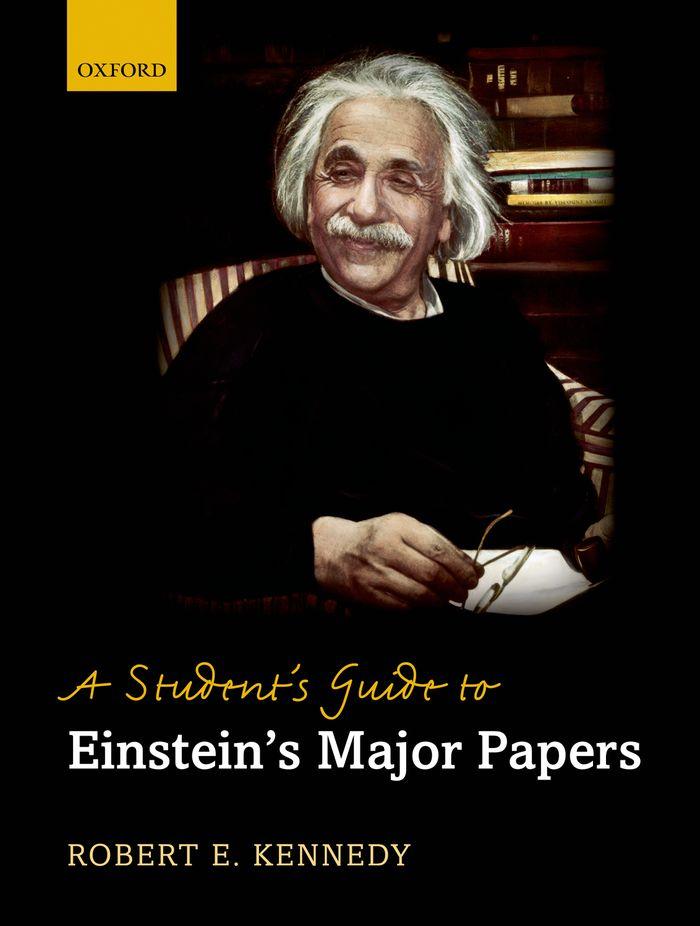
A Student's Guide to Einstein's Major Papers - Robert E. Kennedy


                 Ebook Size : 3.4 MB

              Download : A Student's Guide to Einstein's Major Papers.pdf


 Our understanding of nature underwent a revolution in the early twentieth century – from the classical physics of Galileo, Newton, and Maxwell to the modern physics of relativity and quantum mechanics. The dominant figure in this revolutionary change was Albert Einstein. In 1905, Einstein produced  breakthrough work in three distinct areas of physics: on the size and the effects of atoms; on the quantization of the electromagnetic field; and on the special theory of relativity. In 1916, he produced a fourth breakthrough work, the general theory of relativity. Einstein’s scientific work is the main focus of this book. The book sets many of his major works into their historical context, with an emphasis on the path breaking works of 1905 and 1916. It also develops the detail of his papers, taking the reader through the mathematics to help the reader discover the simplicity and  insightfulness of his ideas and to grasp what was so “revolutionary” about his work.

As with any revolution, the story told after the fact is not always an accurate portrayal of the events and their relation to one another at the time of the revolution. Following Einstein’s work in 1905, more efficient and more convenient ways were found to reach the same results but, in such revisions, many of the original insights were lost. Today, many people hold historically incorrect views of Einstein’s papers, mainly regarding the insights and reasoning that led to the results.

For example:
  • The quantum paper was not written to explain the photoelectric effect, rather, it was written to explain the Wien region of blackbody radiation;
  •  The Brownian motion paper was not written to explain Brownian motion, Einstein was not even certain his work would pertain to Brownian motion;
  •  The relativity paper was not written to explain the Michelson–Morley experiment, etc.

By working through Einstein’s original papers, the reader will gain a better appreciation for Einstein’s revolutionary insights as well as a historically more accurate picture of them. Just as a person cannot hope to appreciate the significance of the American Revolution without some knowledge of the American colonies before 1776, one cannot hope to appreciate the significance of the scientific revolution of the early 1900s without some knowledge of the state of science at that time.

In the early 1900s, our understanding of the world underwent a revolution from the classical physics of Galileo, Newton, and Maxwell to the modern physics of relativity and quantum mechanics. For his role in this revolution, Albert Einstein is justifiably placed with the giants of science – with Galileo, Newton, and Maxwell. In his 1905 papers, Albert Einstein built not only on the state of science as it had evolved over the centuries but also on events in his personal life that shaped his worldview. This chapter presents a context into which Einstein’s work can be placed, leading to a fuller appreciation of his contribution to scientific thought and to a better understanding of the events that influenced his
remarkable achievements.

One of the characteristics that sets physical science apart from mathematics is the demand of agreement with the physical world. As stated by James T. Cushing, “One major difference between the ‘games’ played by theoretical physicists and those played by pure mathematicians is that, aside from meeting the demands of internal consistency and mathematical rigor, a physical model must also meet the inflexible boundary condition of agreeing with physical reality.” It is, as we shall see, this inflexible boundary condition of agreement with physical reality that led to many of Einstein’s insights and provided verification of, or corrective guidance for, his theories.

The science of today is built upon the ideas of those who went before, starting with the ancient Greek thought that nature was orderly, and that this order could be expressed mathematically. This “order” is referred to as the “Laws of Nature.” Major advances in describing these “Laws of Nature” were contributed by Galileo and Newton in the seventeenth century, and by Einstein in the twentieth century.

Thursday, February 14, 2013

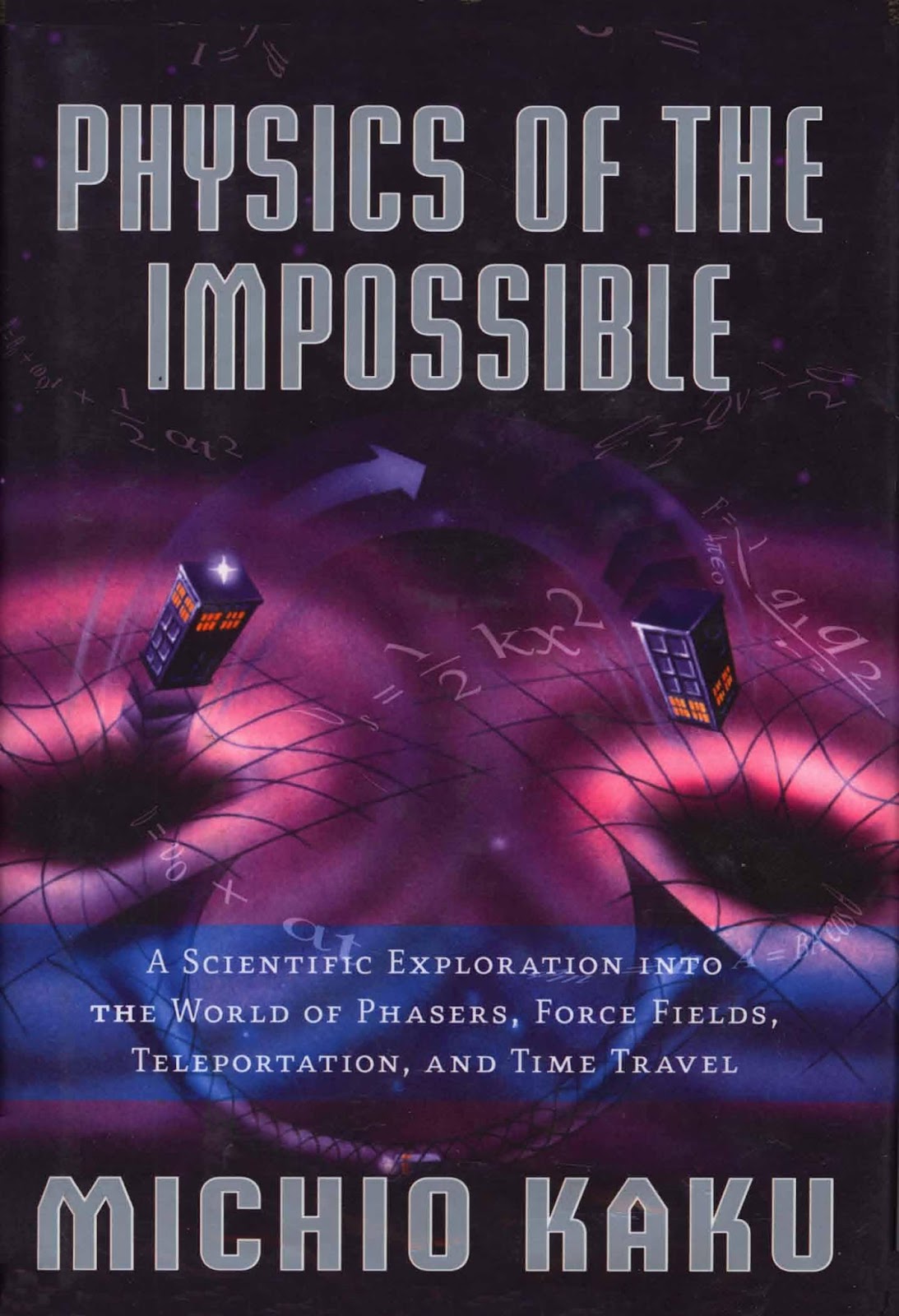
Physics of the Impossible - Michio Kaku


                     Ebooks Size : 4.7 MB

                 Download : Physics of the Impossible.pdf


In countless Star Trek episodes this is the first order that Captain Kirk barks out to the crew, raising the force fields to protect the starship Enterprise against enemy fire. So vital are force fields in Star Trek that the tide of the battle can be measured by how the force field is holding up. Whenever power is drained from the force fields, the Enterprise suffers more and more damaging blows to its hull, until finally surrender is inevitable. So what is a force field? In science fiction it's deceptively simple: a thin, invisible yet impenetrable barrier able to deflect lasers and rock­ets alike. At first glance a force field looks so easy that its creation as a battlefield shield seems imminent. One expects that any day some en­terprising inventor will announce the discovery of a defensive force field. But the truth is far more complicated. 

In the same way that Edison's lightbulb revolutionized modern civilization, a  force field could profoundly affect every aspect of our lives. The military could use force fields to become invulnerable, cre­ating an impenetrable shield against enemy missiles and bullets. Bridges, superhighways, and roads could in theory be built by simply pressing a button. Entire cities could sprout instantly in the desert, with skyscrapers made entirely of force fields. Force fields erected over cities could enable their inhabitants to modify the effects of their weather-high winds, blizzards, tornados-at will. Cities could be built under the oceans within the safe canopy of a force field. Glass, steel, and mortar could be entirely replaced.

Yet oddly enough a force field is perhaps one of the most difficult devices to create in the laboratory. In fact, some physicists believe it might actually be impossible, without modifying its properties.

The concept of force fields originates from the work of the great nine­teenth century British scientist Michael Faraday!

Faraday was born to working-class parents (his father was a black­ smith) and eked out a meager existence as an apprentice bookbinder in the early 1800s. The young Faraday was fascinated by the enormous breakthroughs in uncovering the mysterious properties of two new forces: electricity and magnetism. Faraday devoured all he could con­cerning these topics and attended lectures by Professor Humphrey Davy of the Royal Institution in London.

Sunday, February 3, 2013

Physics FOR DUMMIES - Steven Holzner


             Ebook Size :  7 MB

             Download : Physics FOR DUMMIES.pdf

Physics is the study of your world and the world and universe around
you. You may think of physics as a burden — an obligation placed on
you in school, mostly to be nasty — but it isn’t like that. Physics is a study
that you undertake naturally from the moment you open your eyes.
Nothing falls beyond the scope of physics; it’s an all-encompassing science.
You can study various aspects of the natural world, and, accordingly, you can
study different fields in physics: the physics of objects in motion, of forces, of
electricity, of magnetism, of what happens when you start going nearly as fast
as the speed of light, and so on. You enjoy the study of all these topics and
many more in this book.

Physics has been around as long as people have tried to make sense of their
world. The word “physics” is derived from the Greek word “physika,” which
means “natural things.”

You can observe plenty going on around you all the time in the middle of your
complex world. Leaves are waving, the sun is shining, the stars are twinkling,
light bulbs are glowing, cars are moving, computer printers are printing, people are walking and riding bikes, streams are flowing, and so on. Physics is an inquiry into the world and the way it works, from the most basic (like coming to terms with the inertia of a dead car that you’re trying to push) to the most exotic (like peering into the very tiniest of worlds inside the smallest of particles to try to make sense of the fundamental building blocks of matter).

At root, physics is all about getting conscious about your world.

Physics is all around you, in every commonplace action. But if you want to get
wild, physics is the science to do it. This book finishes off with a roundup of some wild physics: the possibility of wormholes in space, for example, and how the gravitational pull of black holes is too strong for even light to escape.

Enjoy!


Wednesday, December 19, 2012

The Large Scale Structure of Space-Time - Stephen Hawking & G.F.R.Ellis

      
       Ebook Size : 15 MB

       Download : The Large Scale Structure of Space-Time.pdf


In this book we shall study the large scale structure of space-time on the basis of Einstein's General Theory of Relativity. The predictions of this theory are in agreement with all the experiments so far performed. However our treatment will be sufficiently general to cover modifications of Einstein's theory such as the Brans-Dicke theory.

While we expect that most of our readers will have some acquaintance with General Relativity, we have endeavored to write this book so that it is self-contained apart from requiring a knowledge of simple calculus, algebra and point set topology.  We have therefore devoted chapter 2 to differential geometry. Our treatment is reasonably modern in that we have formulated our definitions in a manifestly coordinate independent  manner. However for computational convenience we do use indices at times, and we have for the most part avoided the use of fibre bundles. The reader with some knowledge of differential geometry may wish to skip this chapter.