Summer means different things to different people. It can be a time to broaden horizons by travelling to new places; a time to catch up on news and ideas that have swept past this year; and of course, a time to read. Here, Nature offers the opportunity to do all these things, with a collection of the best and most popular stories published in the magazine’s award-winning News Features section in 2015. The stories include something for all tastes. One feature, on page 7, explores how advances in genetics and developmental biology have been challenging the idea that there is a clear distinction between the sexes, and finds that perhaps sex should be considered as more of a spectrum.
In medicine, the collection includes a story about a largely unrecognized, but pressing global health problem: the astonishing rise in short-sightedness that has been taking place over the past few decades, particularly in Asian countries, and how it might be curbed (page 18). Pluto was thrust into the spotlight this summer when New Horizons reached its quarry, some 4.8 billion kilometres from Earth. A profile in the collection (page 11) tells the story of two scientists, a brother and sister, who have been captivated by the planet since their youth. On page 33, a feature looks at experiments to uncover the nature of the wavefunction – the mysterious entity that lies at the heart of quantum weirdness –and page 41 captures the excitement in the science of 2D materials that has followed the discovery of graphene. Nature’s News Features editors have enjoyed publishing every one of these stories; we hope that your summer is enriched by reading them.
Explaining different scientific disciplines in clear, colorful chapters,
this illustrated primer is a great way to introduce young readers to a
complex topic. In her easily accessible style, Margreet de Heer
visualizes science and makes it approachable for those with little
knowledge of the subject. Touching a number of topics in various
scientific disciplines--including math, chemistry, physics, biology,
geology, and quantum theory--this work ponders questions such as Who exclaimed "Eureka" and why? Why did Galileo get into a fight with the Church? and What happens when you have your DNA tested?
This humorous yet substantive graphic account strips the subject of
unnecessary complexity, making it a perfect introduction to exploring
scientific concepts.
Margreet de Heer lives and works in Amsterdam, The
Netherlands, with her husband Yiri T. Kohl and two cats. A long time
ago, she studied Theology at the University of Amsterdam, but through
divine intervention she ended up being a comic artist. She worked at the
famous comic store Lambiek from 2000 until 2005, and wrote a book about
Dutch comics together with Kees Kousemaker. Since 2005, the same year
she contributed to the 24 Hour Comic Day Anthology, she is a full-time
comic artist producing a wide range of work, from children's comics in
magazines to cartoons at business conferences. In 2007 she started
making philosophical comic "reports" for newspaper Trouw. This resulted
in a book edition in 2010 which was published in the US by NBM
Publishing with the title 'Philosophy: a Discovery in Comics' in 2012.
Margreet continued the series with a comic book about religion in 2011,
followed by one about science in 2012. The latter is published in the US
with the title 'Science: a Discovery in Comics', in September 2013.
What is the meaning and purpose of life for you? Please take a moment to reflect on this question. Whether you have asked yourself this question before or not, it is very helpful to check in from time to time, and ask yourself, with an open heart and open mind, once again. After all, your answer may shift over time, including by reading this book, which lays out a science-based path to help you find a deep sense of meaning and purpose in life. Using science to address life’s meaning and purpose may seem surprising to many. After all, the traditional mainstream approach believes that science can’t answer big life questions –
that’s the job of religion. Well, actually there’s been a wave of recent research in psychology, cognitive neuroscience, and other disciplines on how we can find a rich sense of meaning and purpose in life. The workbook combines an engaging narrative, academic research, and stories from people’s everyday lives, and provides a set of exercises to help you figure out your personal sense of meaning and purpose. In writing this, I drew on my own scholarship on meaning and
purpose, and my experience in giving workshops, teaching classes, creating videos, and writing blog posts that translate such research into practical strategies for finding life meaning and purpose.
Now, many people who come to my workshops and classes are looking for a simple, clear,and straightforward answer to what life is all about. They want certainty about life’s meaning and purpose. Well, I’d love to address life’s meaning and purpose for all people and for all time, but I can’t give the absolute right answer to the big question of “what is the meaning of life.” I don’t deal in sound bites and dogmas.
What I can do in this book is provide you some clear and practical research-based strategies for figuring out a personal sense of life’s meaning and purpose. In other words, I offer the answer to the question “what is the meaning of life for you?” Those who attended my workshops and classes on this topic found these techniques very helpful. One participant stated in an anonymous feedback form that s/he gained “a better understanding of what it means to search for meaning, with the research basis especially greatly contributing to my comprehension.” A second noted that after attending the workshop, “I have a much better sense of how to consider questions of meaning and purpose.” A third wrote that “from attending this workshop, I have gained the basic knowledge for greater self-exploration.” Several chose to give videotaped interviews about their experience in a workshop on meaning and purpose. They kindly permitted me to include their names and links to their videotaped feedback, for example Ryan Mulholand; Brenda Penn; Karen Thimmes, and Jake
Calaway. Their descriptions of their experience testifies to how much they benefitted from engaging with the research-based strategies to finding a deeper sense of meaning and purpose in life. I got in touch with some of these workshop participants a few weeks after the workshop, to see whether it influenced them in the long term. It did. The most illustrative statement came from Ryan, whose story I will share throughout this book. Ryan, who is a 21-year-old college student, stated that when he first came to the workshop, “my original highest order goals revolved largely around living a comfortable life.” Yet in the course of the workshop, he realized that “the issue with this mindset was that it was too shallow and self-centered for me to be content with for long.” As a result of the workshop, he stated that “ “I reached several conclusions in what I desired most out of life. I figured out that I wanted to build a life that was centered around bettering myself and other people. I wanted to be someone who constantly was learning and growing, while at the same time, being a teacher of sorts to help
those around me... With these thoughts in mind, I promptly changed my major and have since then, begun to work toward making these wants into realities.” His full statement describing his experience is available here.
A new edition of the most definitive collection of Albert Einstein's
popular writings, gathered under the supervision of Einstein himself.
The selections range from his earliest days as a theoretical physicist
to his death in 1955; from such subjects as relativity, nuclear war or
peace, and religion and science, to human rights, economics, and
government.
IDEAS AND OPINIONS contains essays by eminent scientist Albert Einstein
on subjects ranging from atomic energy, relativity, and religion to
human rights, government, and economics. Previously published articles,
speeches, and letters are gathered here to create a fascinating
collection of meditations by one of the world's greatest minds.
--This text refers to an out of print or unavailable edition of this title.
"Ideas and Opinions reveals Albert Einstein, perhaps the greatest
scientist of all time, as a whole human being . . . a deeply moral and
philosophical thinker, whose clarity in human affairs matched his
clarity in science. . . . Purity and inspiration shine through every page of this extraordinary book."
--Alan Lightman
--This text refers to the
Hardcover
edition.
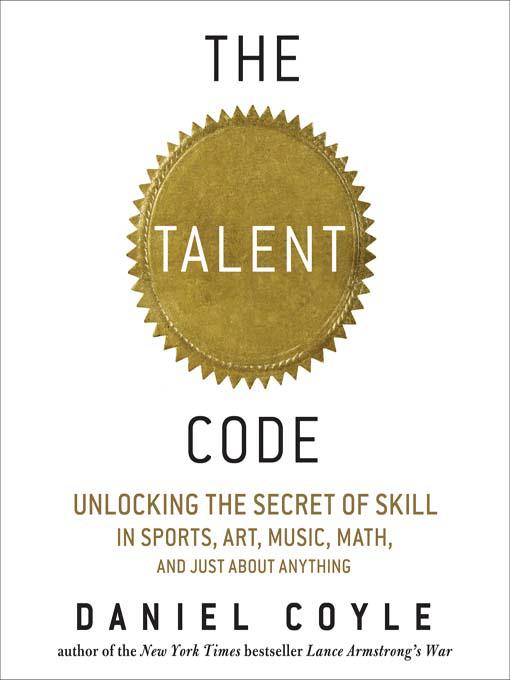
What is the secret of talent? How do we unlock it? In this
groundbreaking work, journalist and New York Times bestselling author
Daniel Coyle provides parents, teachers, coaches, businesspeople—and
everyone else—with tools they can use to maximize potential in
themselves and others.
Whether you’re coaching soccer or teaching
a child to play the piano, writing a novel or trying to improve your
golf swing, this revolutionary book shows you how to grow talent by
tapping into a newly discovered brain mechanism.
Drawing on
cutting-edge neurology and firsthand research gathered on journeys to
nine of the world’s talent hotbeds—from the baseball fields of the
Caribbean to a classical-music academy in upstate New York—Coyle
identifies the three key elements that will allow you to develop your
gifts and optimize your performance in sports, art, music, math, or just
about anything.
• Deep Practice--Everyone knows that practice
is a key to success. What everyone doesn’t know is that specific kinds
of practice can increase skill up to ten times faster than conventional
practice.
• Ignition--We all need a little motivation to get
started. But what separates truly high achievers from the rest of the
pack? A higher level of commitment—call it passion—born out of our
deepest unconscious desires and triggered by certain primal cues.
Understanding how these signals work can help you ignite passion and
catalyze skill development.
• Master Coaching--What are the
secrets of the world’s most effective teachers, trainers, and coaches?
Discover the four virtues that enable these “talent whisperers” to fuel
passion, inspire deep practice, and bring out the best in their
students.
These three elements work together within your brain to
form myelin, a microscopic neural substance that adds vast amounts of
speed and accuracy to your movements and thoughts. Scientists have
discovered that myelin might just be the holy grail: the foundation of
all forms of greatness, from Michelangelo’s to Michael Jordan’s. The
good news about myelin is that it isn’t fixed at birth; to the contrary,
it grows, and like anything that grows, it can be cultivated and
nourished.
Combining revelatory analysis with illuminating
examples of regular people who have achieved greatness, this book will
not only change the way you think about talent, but equip you to reach
your own highest potential.