Showing posts with label nature. Show all posts

Thursday, August 20, 2015

nature collections - Nature's Summer Reads


              Ebook Size: 13.8 MB

              Download: Nature Summer Reads

Summer means different things to different people. It can be a time to broaden horizons by travelling to new places; a time to catch up on news and ideas that have swept past this year; and of course, a time to read. Here, Nature offers the opportunity to do all these things, with a collection of the best and most popular stories published in the magazine’s award-winning News Features section in 2015. The stories include something for all tastes. One feature, on page 7, explores how advances in genetics and developmental biology have been challenging the idea that there is a clear distinction between the sexes, and finds that perhaps sex should be considered as more of a spectrum.

In medicine, the collection includes a story about a largely unrecognized, but pressing global health problem: the astonishing rise in short-sightedness that has been taking place over the past few decades, particularly in Asian countries, and how it might be curbed (page 18). Pluto was thrust into the spotlight this summer when New Horizons reached its quarry, some 4.8 billion kilometres from Earth. A profile in the collection (page 11) tells the story of two scientists, a brother and sister, who have been captivated by the planet since their youth. On page 33, a feature looks at experiments to uncover the nature of the wavefunction – the mysterious entity that lies at the heart of quantum weirdness –and page 41 captures the excitement in the science of 2D materials that has followed the discovery of graphene. Nature’s News Features editors have enjoyed publishing every one of these stories; we hope that your summer is
enriched by reading them.

Wednesday, February 20, 2013

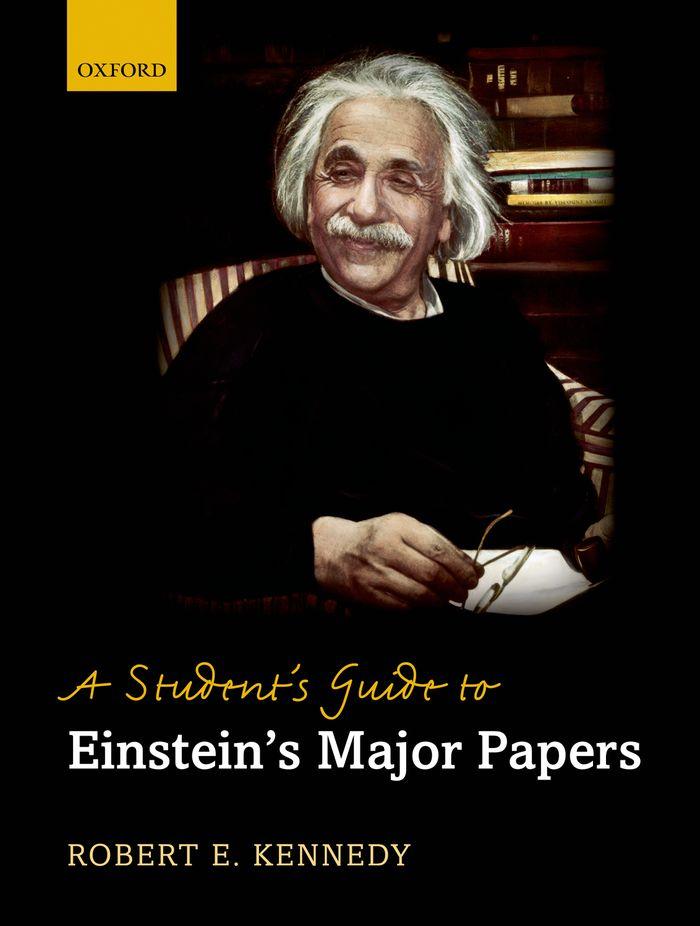
A Student's Guide to Einstein's Major Papers - Robert E. Kennedy


                 Ebook Size : 3.4 MB

              Download : A Student's Guide to Einstein's Major Papers.pdf


 Our understanding of nature underwent a revolution in the early twentieth century – from the classical physics of Galileo, Newton, and Maxwell to the modern physics of relativity and quantum mechanics. The dominant figure in this revolutionary change was Albert Einstein. In 1905, Einstein produced  breakthrough work in three distinct areas of physics: on the size and the effects of atoms; on the quantization of the electromagnetic field; and on the special theory of relativity. In 1916, he produced a fourth breakthrough work, the general theory of relativity. Einstein’s scientific work is the main focus of this book. The book sets many of his major works into their historical context, with an emphasis on the path breaking works of 1905 and 1916. It also develops the detail of his papers, taking the reader through the mathematics to help the reader discover the simplicity and  insightfulness of his ideas and to grasp what was so “revolutionary” about his work.

As with any revolution, the story told after the fact is not always an accurate portrayal of the events and their relation to one another at the time of the revolution. Following Einstein’s work in 1905, more efficient and more convenient ways were found to reach the same results but, in such revisions, many of the original insights were lost. Today, many people hold historically incorrect views of Einstein’s papers, mainly regarding the insights and reasoning that led to the results.

For example:
  • The quantum paper was not written to explain the photoelectric effect, rather, it was written to explain the Wien region of blackbody radiation;
  •  The Brownian motion paper was not written to explain Brownian motion, Einstein was not even certain his work would pertain to Brownian motion;
  •  The relativity paper was not written to explain the Michelson–Morley experiment, etc.

By working through Einstein’s original papers, the reader will gain a better appreciation for Einstein’s revolutionary insights as well as a historically more accurate picture of them. Just as a person cannot hope to appreciate the significance of the American Revolution without some knowledge of the American colonies before 1776, one cannot hope to appreciate the significance of the scientific revolution of the early 1900s without some knowledge of the state of science at that time.

In the early 1900s, our understanding of the world underwent a revolution from the classical physics of Galileo, Newton, and Maxwell to the modern physics of relativity and quantum mechanics. For his role in this revolution, Albert Einstein is justifiably placed with the giants of science – with Galileo, Newton, and Maxwell. In his 1905 papers, Albert Einstein built not only on the state of science as it had evolved over the centuries but also on events in his personal life that shaped his worldview. This chapter presents a context into which Einstein’s work can be placed, leading to a fuller appreciation of his contribution to scientific thought and to a better understanding of the events that influenced his
remarkable achievements.

One of the characteristics that sets physical science apart from mathematics is the demand of agreement with the physical world. As stated by James T. Cushing, “One major difference between the ‘games’ played by theoretical physicists and those played by pure mathematicians is that, aside from meeting the demands of internal consistency and mathematical rigor, a physical model must also meet the inflexible boundary condition of agreeing with physical reality.” It is, as we shall see, this inflexible boundary condition of agreement with physical reality that led to many of Einstein’s insights and provided verification of, or corrective guidance for, his theories.

The science of today is built upon the ideas of those who went before, starting with the ancient Greek thought that nature was orderly, and that this order could be expressed mathematically. This “order” is referred to as the “Laws of Nature.” Major advances in describing these “Laws of Nature” were contributed by Galileo and Newton in the seventeenth century, and by Einstein in the twentieth century.

Sunday, January 20, 2013

The Origin of Species - Charles Darwin


 Ebook Size: 9.2 MB


WHEN on board H.M.S. ' Beagle,' as naturalist, I was much struck with certain facts in the distribution of the organic beings inhabiting South America, and in the geological relations of the present to the past inhabitants of that continent. These facts, as will be seen in the latter chapters of this volume, seemed to throw some light on the origin of species—that mystery of mysteries, as it has been called by one of our greatest philosophers. On my return home, it occurred to me, in 1837, that something might perhaps be made out on this question by patiently accumulating and reflecting on all sorts of facts which could possibly have any bearing on it. After five years' work I allowed myself to speculate on the subject, and drew up some short notes ; these I enlarged in 1844 into a sketch of the conclusions, which then seemed to me probable : from that period to the present day I have steadily pursued the same object. I hope that I may be excused for entering on these personal details, as I give them to show that I have not been hasty in coming to a decision.

My work is now (1859) nearly finished; but as it will take me many more years to complete it, and as my health is far from strong, I have been urged to publish this Abstract. I have more especially been induced to do this, as Mr. Wallace, who is now studying the natural history of the Malay archipelago, has arrived
at almost exactly the same general conclusions that I have on the origin of species. In 1858 he sent me a memoir on this subject, with a request that I would forward it to Sir Charles Lyell, who sent it to the Linnean Society, and it is published in the third volume of the Journal of that Society. Sir C. Lyell and Dr. Hooker, who both knew of my work—the latter having read my sketch of 1844 :— honoured me by thinking it advisable to publish, with Mr. Wallace's excellent  memoir, some brief extracts from my manuscripts.

This Abstract, which I now publish, must necessarily be imperfect. I cannot here give references and authorities for my several statements; and I must trust to the reader reposing some confidence in my accuracy. No doubt errors will have crept in, though I hope I have always been cautious in trusting to good authorities alone. I can here give only the general conclusions at which I have arrived, with a few facts in illustration, but which, I hope, in most cases will suffice. No one can feel more sensible than I do of the necessity of hereafter publishing in detail all the facts, with references, on which my conclusions have been grounded; and I hope in a future work to do this. For I am well aware that scarcely a single point is discussed in this volume on which facts cannot be adduced, often apparently leading to conclusions directly opposite to those at which I have arrived. A fair result can be obtained only by fully stating and balancing the facts and arguments on both sides of each question; and this is here impossible.