
Ebook Size : 3.4 MB
Download : A Student's Guide to Einstein's Major Papers.pdf
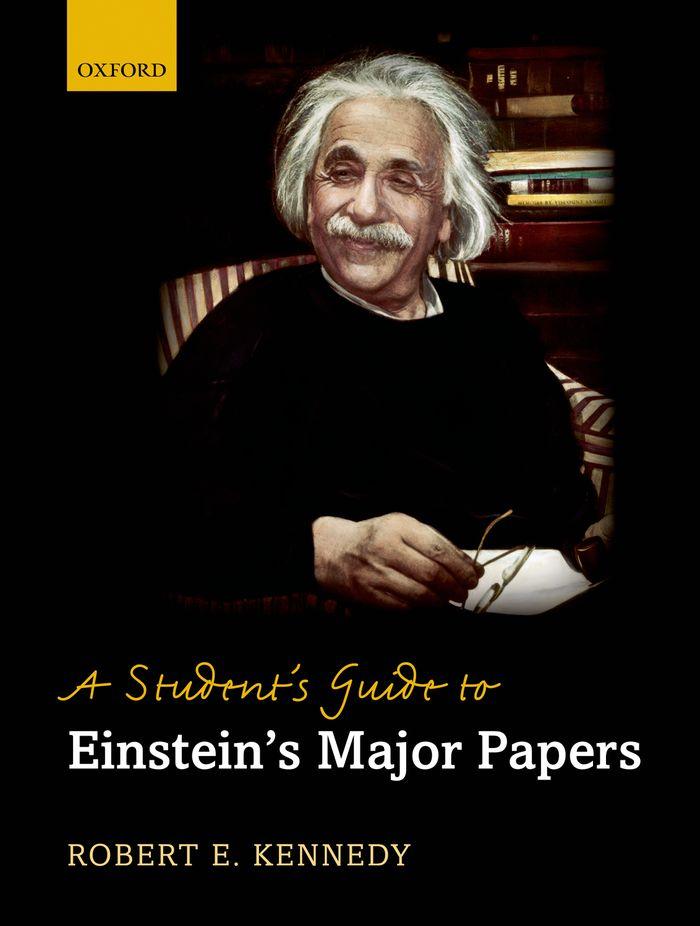
Our understanding of nature underwent a revolution in the early twentieth century – from the classical physics of Galileo, Newton, and Maxwell to the modern physics of relativity and quantum mechanics. The dominant figure in this revolutionary change was Albert Einstein. In 1905, Einstein produced breakthrough work in three distinct areas of physics: on the size and the effects of atoms; on the quantization of the electromagnetic field; and on the special theory of relativity. In 1916, he produced a fourth breakthrough work, the general theory of relativity. Einstein’s scientific work is the main focus of this book. The book sets many of his major works into their historical context, with an emphasis on the path breaking works of 1905 and 1916. It also develops the detail of his papers, taking the reader through the mathematics to help the reader discover the simplicity and insightfulness of his ideas and to grasp what was so “revolutionary” about his work.
As with any revolution, the story told after the fact is not always an accurate portrayal of the events and their relation to one another at the time of the revolution. Following Einstein’s work in 1905, more efficient and more convenient ways were found to reach the same results but, in such revisions, many of the original insights were lost. Today, many people hold historically incorrect views of Einstein’s papers, mainly regarding the insights and reasoning that led to the results.
For example:
- The quantum paper was not written to explain the photoelectric effect, rather, it was written to explain the Wien region of blackbody radiation;
- The Brownian motion paper was not written to explain Brownian motion, Einstein was not even certain his work would pertain to Brownian motion;
- The relativity paper was not written to explain the Michelson–Morley experiment, etc.
By working through Einstein’s original papers, the reader will gain a better appreciation for Einstein’s revolutionary insights as well as a historically more accurate picture of them. Just as a person cannot hope to appreciate the significance of the American Revolution without some knowledge of the American colonies before 1776, one cannot hope to appreciate the significance of the scientific revolution of the early 1900s without some knowledge of the state of science at that time.
In the early 1900s, our understanding of the world underwent a revolution from the classical physics of Galileo, Newton, and Maxwell to the modern physics of relativity and quantum mechanics. For his role in this revolution, Albert Einstein is justifiably placed with the giants of science – with Galileo, Newton, and Maxwell. In his 1905 papers, Albert Einstein built not only on the state of science as it had evolved over the centuries but also on events in his personal life that shaped his worldview. This chapter presents a context into which Einstein’s work can be placed, leading to a fuller appreciation of his contribution to scientific thought and to a better understanding of the events that influenced his
remarkable achievements.
One of the characteristics that sets physical science apart from mathematics is the demand of agreement with the physical world. As stated by James T. Cushing, “One major difference between the ‘games’ played by theoretical physicists and those played by pure mathematicians is that, aside from meeting the demands of internal consistency and mathematical rigor, a physical model must also meet the inflexible boundary condition of agreeing with physical reality.” It is, as we shall see, this inflexible boundary condition of agreement with physical reality that led to many of Einstein’s insights and provided verification of, or corrective guidance for, his theories.
The science of today is built upon the ideas of those who went before, starting with the ancient Greek thought that nature was orderly, and that this order could be expressed mathematically. This “order” is referred to as the “Laws of Nature.” Major advances in describing these “Laws of Nature” were contributed by Galileo and Newton in the seventeenth century, and by Einstein in the twentieth century.

