Showing posts with label Quantum Mechanics. Show all posts

Monday, October 3, 2016

Hacking Matter - Wil McCarthy


   Ebook Size : 2.3 MB

   Download : Hacking Matter - WIL MCCARTHY


"When he experimented with lightning, Ben Franklin mused that electricity 'might someday prove of use.' Now comes Wil McCarthy, offering a peek at something so potentially transforming, our grandchildren may build civilizations around it. If even a few of these possibilities come true, you'll always remember you heard it here first." -- David Brin, author of The Transparent Society

"Programmable substances and futuristic computers will revolutionize our lives and allow us to soar beyond the limits of our intuition. No book better describes the impact of hypercomputing and the dazzling wealth of new materils coming our way than Hacking Matter." -- Clifford A. Pickover, author of The Mathematics of Oz

"A grand tour of cutting-edge research: alchemy, 21st century style. The author makes an informative case for the promising, even magical, potential of programmable atoms." -- Publishers Weekly

McCarthy effectively conveys the inherent gee-whiz character of his subject. A fascinating glimpse of research that may in a few years find its way into our everyday lives." --Kirkus Reviews

"[T]he book's science is solid and McCarthy's fervor genuinely infectious. The future never felt so close." -- Jennifer Kahn, WIRED


"McCarthy blends lucid nuts-and-bolts explanations of 'quantum dots' and other developing technologies with healthy doses of 'You ain't seen nothin' yet' descriptions of speculative applications. A fascinating book for any reader intrigued by new technologies." -- Barnes and Noble

"Promises to create a thunderclap of change. McCarthy takes a fantastical concept, coolly explaining it in a plausible way, and helps even the most science-deficient reader to understand how 'hacking matter' works, and what it means for all of us." -- Dallas Morning News
 
At the nanoscale, where we find very tiny, very simple objects like the water molecule (about 0.3 nm across at its widest), these rules barely apply at all. Instead, the behavior of particles is governed by quantum mechanics, that elusive and slippery physics pioneered in the time of Einstein. Quantum mechanics is almost completely counterintuitive; your "gut feel" about how a particle should behave is virtually useless for predicting what it will actually do. This is because on the nanoscale, what we call "particles" are really probability waves -- regions where a particle-like phenomenon is more or less likely to occur. Probability waves can do "impossible" things like leaping across an impenetrable barrier, or existing in many places at the same time, or apparently predicting the future, or being influenced by distant events much faster than the speed of light should allow.

Wednesday, February 20, 2013

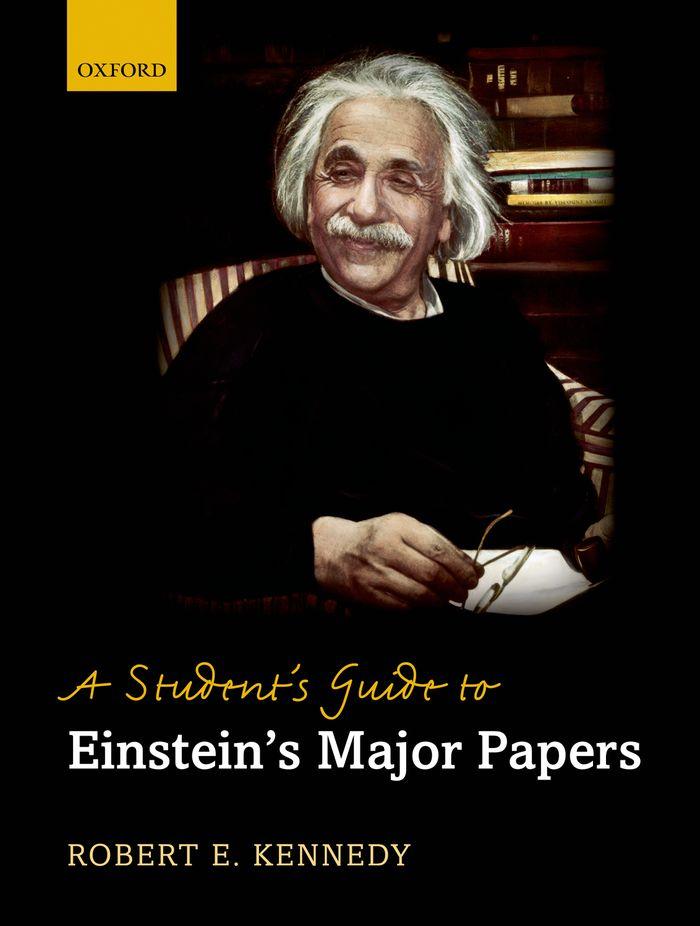
A Student's Guide to Einstein's Major Papers - Robert E. Kennedy


                 Ebook Size : 3.4 MB

              Download : A Student's Guide to Einstein's Major Papers.pdf


 Our understanding of nature underwent a revolution in the early twentieth century – from the classical physics of Galileo, Newton, and Maxwell to the modern physics of relativity and quantum mechanics. The dominant figure in this revolutionary change was Albert Einstein. In 1905, Einstein produced  breakthrough work in three distinct areas of physics: on the size and the effects of atoms; on the quantization of the electromagnetic field; and on the special theory of relativity. In 1916, he produced a fourth breakthrough work, the general theory of relativity. Einstein’s scientific work is the main focus of this book. The book sets many of his major works into their historical context, with an emphasis on the path breaking works of 1905 and 1916. It also develops the detail of his papers, taking the reader through the mathematics to help the reader discover the simplicity and  insightfulness of his ideas and to grasp what was so “revolutionary” about his work.

As with any revolution, the story told after the fact is not always an accurate portrayal of the events and their relation to one another at the time of the revolution. Following Einstein’s work in 1905, more efficient and more convenient ways were found to reach the same results but, in such revisions, many of the original insights were lost. Today, many people hold historically incorrect views of Einstein’s papers, mainly regarding the insights and reasoning that led to the results.

For example:
  • The quantum paper was not written to explain the photoelectric effect, rather, it was written to explain the Wien region of blackbody radiation;
  •  The Brownian motion paper was not written to explain Brownian motion, Einstein was not even certain his work would pertain to Brownian motion;
  •  The relativity paper was not written to explain the Michelson–Morley experiment, etc.

By working through Einstein’s original papers, the reader will gain a better appreciation for Einstein’s revolutionary insights as well as a historically more accurate picture of them. Just as a person cannot hope to appreciate the significance of the American Revolution without some knowledge of the American colonies before 1776, one cannot hope to appreciate the significance of the scientific revolution of the early 1900s without some knowledge of the state of science at that time.

In the early 1900s, our understanding of the world underwent a revolution from the classical physics of Galileo, Newton, and Maxwell to the modern physics of relativity and quantum mechanics. For his role in this revolution, Albert Einstein is justifiably placed with the giants of science – with Galileo, Newton, and Maxwell. In his 1905 papers, Albert Einstein built not only on the state of science as it had evolved over the centuries but also on events in his personal life that shaped his worldview. This chapter presents a context into which Einstein’s work can be placed, leading to a fuller appreciation of his contribution to scientific thought and to a better understanding of the events that influenced his
remarkable achievements.

One of the characteristics that sets physical science apart from mathematics is the demand of agreement with the physical world. As stated by James T. Cushing, “One major difference between the ‘games’ played by theoretical physicists and those played by pure mathematicians is that, aside from meeting the demands of internal consistency and mathematical rigor, a physical model must also meet the inflexible boundary condition of agreeing with physical reality.” It is, as we shall see, this inflexible boundary condition of agreement with physical reality that led to many of Einstein’s insights and provided verification of, or corrective guidance for, his theories.

The science of today is built upon the ideas of those who went before, starting with the ancient Greek thought that nature was orderly, and that this order could be expressed mathematically. This “order” is referred to as the “Laws of Nature.” Major advances in describing these “Laws of Nature” were contributed by Galileo and Newton in the seventeenth century, and by Einstein in the twentieth century.

Thursday, August 2, 2012

Problems And Solutions On Atomic Nuclear And Particle Physics - Yung-Kuo Lim


                    Ebook Size : 3 MB

                    Download : Problems And Solutions On Atomic Nuclear And Particle Physics.pdf

 Solving problems in course work is an exercise of the mental facilities, and examination problems are usually chosen, or set similar to such problems. Working out problems is thus an essential and important aspect of
the study of physics.

The series Major American University Ph.D. Qualifying Questions and Solutions comprises seven volumes and is the result of months of work of a number of Chinese physicists. The subjects of the volumes and the
respective coordinators are as follows:

1. Mechanics (Qiang Yan-qi, Gu En-pu, Cheng Jia-fu, Li Ze-hua, Yang De-tian)
2. Electromagnetism (Zhao Shu-ping, You Jun-han, Zhu Jun-jie)
3. Optics (Bai Gui-ru, Guo Guang-can)
4. Atomic, Nuclear and Particle Physics (Jin Huai-cheng, Yang Bao-zhong, Fan Yang-mei)
5. Thermodynamics and Statistical Physics (Zheng Jiu-ren)
6. Quantum Mechanics (Zhang Yong-de, Zhu Dong-pei, Fan Hong-yi)
7. Solid State Physics and Miscellaneous Topics (Zhang Jia-lu, Zhou
You-yuan, Zhang Shi-ling).

These volumes, which cover almost all aspects of university physics, contain 2550 problems, mostly solved in detail. The problems have been carefully chosen from a total of 3100 problems, collected from the China-U.S.A. Physics Examination and Application Program, the Ph.D. Qualifying Examination on Experimental High Energy Physics sponsored by Chao-Chong Ting, and the graduate qualifying examinations of seven world-renowned American universities: Columbia University, the University of California at Berkeley, Massachusetts Institute of Technology, the University of Wisconsin, the University of Chicago,Princeton University, and the State University of New York at Buffalo.

Generally speaking, examination problems in physics in American universities do not require too much mathematics. They can be characterized to a large extent as follows. Many problems are concerned with the
various frontier subjects and overlapping domains of topics, having been selected from the setters own research encounters. These problems show a “modern” flavor. Some problems involve a wide field and require a sharp mind for their analysis, while others require simple and practical methods demanding a fine “touch of physics”. Indeed, we believe that these problems, as a whole, reflect to some extent the characteristics of American science and culture, as well as give a glimpse of the philosophy underlying American education.

Monday, July 16, 2012

String Theory Demystified - David McMahon


Ebook Size : 3.8 MB

Download : String Theory Demystified.pdf

String theory is the greatest scientific quest of all time. Its goal is nothing other than a complete description of physical reality—at least at the level of fundamental particles, interactions, and perhaps space-time itself. In principle, once the fundamental theory is fully known, one could derive relativity and quantum theory as low energy limits to strings. The theory sets out to do what no other has been able to since the early twentieth century—combine general relativity and quantum theory into a single unified framework. This is an ambitious program that has occupied the best minds in mathematics and physics for decades. Einstein himself failed, but he lacked key ingredients that are necessary to pull it off.
 
String theory comes attached with a bit of controversy. As anyone who is reading this book likely knows, experimentally testing it is not an immediately accessible option due to the high energies required. It is, after all, a theory of creation itself so the energies associated with string theory are of course very large. Nonetheless, it now appears that some indirect tests are possible and the timing of this book may coincide with some of this program. The first clue will be the continued search for supersymmetry, the theory that proposes fermions and bosons have superpartners, that is, a fermion like an electron has a sister Superpartner particle that is a boson. Superparticles have not been discovered, so if it exists supersymmetry must be broken somehow so that the super partners have high mass. This could explain why we haven’t seen them so far. But the Large Hadron Collider being constructed in Europe as we speak may be able to discover evidence of supersymmetry. This does not prove string theory, because you can have Supersymmetry work just fine with point particles. However, supersymmetry is absolutely essential for string theory to work. If supersymmetry does not exist, string theory cannot be true. If supersymmetry is found, while it does not prove string theory, it is a good indication that string theory might be right.

General relativity and quantum mechanics stand out as the pillars of twentieth century science, able to escribe almost all known phenomena from the scale of subatomic particles all the way up to the rotations of galaxies and even the history of the universe itself. Despite this grand success, which includes stunning agreement with experiment, these two theories represent physics at a crossroads—one that is plagued with crisis and controversy.

The problem is that at first sight, these two theories are at complete odds with each other. The general theory of relativity (GR), Einstein’s crowning achievement, describes gravitational interactions, that is, interactions that occur on the largest scales that we know. But it not only stands out as Einstein’s greatest contribution to science but it also might be called the last classical theory of physics. That is, despite its revolutionary nature, GR does not take quantum mechanics into account at all. Since experiment indicates that quantum mechanics is the correct description for the behavior of matter, this is a serious flaw in the theory of general relativity.

We don’t think about this under normal circumstances because quantum effects only become important in gravitational interactions that are extremely strong or taking place over very small scales. In the situations where we might apply general relativity, say to the motion of the planet mercury around the sun or the motion of the galaxies, quantum effects are not important at all. Two places where they will be important are in black hole physics and in the birth of the universe. We might also see quantum effects on gravity in very high energy particle interactions.

On the other hand, quantum mechanics basically ignores the insights of relativity. It basically pretends gravity doesn’t exist at all, and pretends that space and time are not on the same footing. The notion of space-time does not enter in quantum mechanics, and although special relativity plays a central role in quantum field theory, gravitational interactions are nowhere to be found there either.